
| Best Overall | Best Value | Best Whole-Root Capsule | |
|---|---|---|---|
| Pick | PURE CO Organic Dandelion Root 10:1 Extract | Micro Ingredients Organic Dandelion Root Extract Powder | Nature’s Way Dandelion Root 1,575 mg |
| Why | 500 mg of organic root extract in one capsule, labeled as equal to 5,000 mg of root. | Organic root extract powder with nothing added, for about 7 cents a day. | Plain dandelion root powder from a long-running herbal brand. |
| Cost per day | $ | $ | $$ |
Quick answer: Of the dandelion root supplements we compared, PURE CO Organic Dandelion Root 10:1 Extract is the best choice for most people: one capsule holds 500 mg of organic root extract, the most root per capsule here by the label’s own math, for about 21 cents a day. Micro Ingredients Organic Dandelion Root Extract Powder is the value pick for tea or smoothies, and Nature’s Way Dandelion Root is the pick if you want whole root powder rather than an extract.
Dandelion (Taraxacum officinale) is the common yard plant, and its root has a long history as a bitter herb for digestion and as a mild diuretic. The European Medicines Agency recognizes dandelion root for traditional use in mild digestive complaints, temporary loss of appetite and flushing the urinary tract, based on long-standing use rather than clinical trials.
Human research on dandelion root is thin. The one small human diuretic study used a leaf extract, not root, and most other findings come from lab and animal work. Dandelion root is not a treatment for liver disease, kidney disease, high blood pressure or cancer.
We compared eight dandelion root supplements on how much root each serving gives, extract type, testing claims, other ingredients, cost per day and who sells the listing, plus recent FDA recalls, using our how we test criteria. Every product here made our shortlist, and our ratings show how they rank against each other. Where two products scored the same or very close, we explain the order in their reviews.
Our Top Picks
Best Overall: PURE CO Organic Dandelion Root 10:1 Extract – CHECK PRICE →
Best Value: Micro Ingredients Organic Dandelion Root Extract Powder – CHECK PRICE →
Best Whole-Root Capsule: Nature’s Way Dandelion Root 1,575 mg – CHECK PRICE →
Best Liquid: MaryRuth’s Organic Dandelion Root Liquid Extract – CHECK PRICE →
Comparison Table
| Rank | Product | Form | Per Serving | Root Equivalent (Label) | Cost per Day | Best For |
|---|---|---|---|---|---|---|
| 1 | PURE CO | Organic 10:1 extract capsules | 500 mg (1 capsule) | 5,000 mg | $ | Best Overall |
| 2 | Zazzee | Organic 10:1 extract capsules | 300 mg (1 capsule) | 3,000 mg | $ | Most-Reviewed Extract |
| 3 | Micro Ingredients | Organic extract powder | 1 g (1 scoop) | Not stated | $ | Value |
| 4 | Nature’s Way | Root powder capsules | 1,575 mg (3 capsules) | 1,575 mg | $$ | Whole-Root Capsule |
| 5 | Oregon’s Wild Harvest | Organic root powder capsules | 1,200 mg (3 capsules) | 1,200 mg | $$$ | Simplest Label |
| 6 | MaryRuth’s | Organic liquid extract (1:5) | 1 mL | About 200 mg | $$$ | Liquid |
| 7 | Himalaya | Root capsules | 1,000 mg (2 capsules) | 1,000 mg | $$$ | Two-Capsule Option |
| 8 | Wild & Organic | Organic 10:1 extract drops | 65 mg (0.7 mL) | 650 mg | $$$ | Sweet-Tasting Drops |
Cost tiers per day at the label serving: $ under $0.25 · $$ $0.25–$0.50 · $$$ over $0.50 (checked November 2026). Root equivalents are the brands’ own figures for extracts.
In-Depth Reviews: Top 8 Dandelion Root Supplements of 2026
1. PURE CO Organic Dandelion Root 10:1 Extract – Best Overall
Our rating: 4.8/5

Cost per serving: $ | 120 servings | 1 capsule per serving
The most dandelion root per capsule here, in a short organic label.
Quick Stats
- Active ingredient + form: Organic dandelion (Taraxacum officinale) root 10:1 extract in capsules
- Dose per serving: 500 mg (1 capsule), which the brand says equals 5,000 mg of root
- Dose vs. tradition: Within the 2 to 15 g of dried root a day in the European herbal monograph, by the label’s 10:1 math
- Third-party tested: The listing says “lab verified” but does not name a lab
- Certifications: USDA Organic, vegan
- Who should skip: People allergic to ragweed, daisies or other plants in the daisy family, pregnant or breastfeeding women, people with gallstones or bile duct problems, and anyone taking diuretics or diabetes medicines unless their doctor approves
What We Like
The only other ingredients are a pullulan capsule and organic rice hull, a bottle lasts four months, and the brand sells the listing. PURE CO, Zazzee and Micro Ingredients scored the same, and PURE CO ranks first because each capsule gives the most root by its label.
Watch Out For
The 5,000 mg figure is the brand’s conversion from a 10:1 extract, not a measured amount of compounds. The buyer base is smaller than Zazzee’s.
What Buyers Report
Buyers frequently mention good quality, capsules that are easy to swallow and few side effects.
The review base is too small to show clear complaints.
Bottom Line: The most root per capsule here, at a low daily cost.
2. Zazzee Organic Dandelion Root 10:1 Extract – Most-Reviewed Extract Capsule
Our rating: 4.7/5

Cost per serving: $ | 120 servings | 1 capsule per serving
A one-a-day organic root extract with a large buyer base.
Quick Stats
- Active ingredient + form: Organic dandelion root 10:1 extract in capsules
- Dose per serving: 300 mg (1 capsule), which the brand says equals 3,000 mg of root
- Dose vs. tradition: Within the 2 to 15 g of dried root a day in the European herbal monograph, by the label’s 10:1 math
- Third-party tested: The listing shows a lab-tested badge but does not name a lab
- Certifications: USDA Organic, vegan; made in a cGMP facility in the USA (brand claim)
- Who should skip: People allergic to ragweed, daisies or other plants in the daisy family, pregnant or breastfeeding women, people with gallstones or bile duct problems, and anyone taking diuretics or diabetes medicines unless their doctor approves
What We Like
It has the largest buyer base of the extract capsules here, the brand sells the listing, and a bottle lasts four months at about 25 cents a day. It ranks behind PURE CO only because each capsule gives less root by the label.
Watch Out For
The capsule adds organic rice powder and a natural fiber flow agent. About a third of buyers who mention side effects report stomach upset or loose stools.
What Buyers Report
Buyers frequently mention less bloating and water retention, easier digestion and capsules that are easy to swallow.
The most common complaints are stomach discomfort and loose stools.
Bottom Line: A popular one-a-day extract with a clean label.
3. Micro Ingredients Organic Dandelion Root Extract Powder – Best Value
Our rating: 4.6/5

Cost per serving: $ | 454 servings | 1 scoop (1 g) per serving
Organic root extract powder with nothing else in the pouch.
Quick Stats
- Active ingredient + form: Organic dandelion root extract powder
- Dose per serving: 1,000 mg (1 scoop)
- Dose vs. tradition: The label does not give an extract ratio, so the root equivalent is unknown
- Third-party tested: The brand says it is third-party lab tested but does not name a lab
- Certifications: USDA Organic (label)
- Who should skip: People allergic to ragweed, daisies or other plants in the daisy family, pregnant or breastfeeding women, people with gallstones or bile duct problems, and anyone taking diuretics or diabetes medicines unless their doctor approves
What We Like
The label lists “Other Ingredients: None,” a pouch lasts over a year at one scoop a day, and it costs about 7 cents a day. Powder dissolves in hot water for a quick tea and lets you adjust the amount. The brand’s parent company sells the listing.
Watch Out For
Without an extract ratio, you cannot tell how much root one scoop equals. It ranks behind the two capsules for that reason. Some buyers dislike the aroma.
What Buyers Report
Buyers frequently mention a mild flavor, that it dissolves well in hot drinks and smoothies, and good value.
About a quarter of flavor comments are negative, and opinions on the aroma are split.
Bottom Line: The lowest daily cost here, for a tea you mix yourself.
4. Nature’s Way Dandelion Root 1,575 mg – Best Whole-Root Capsule
Our rating: 4.5/5
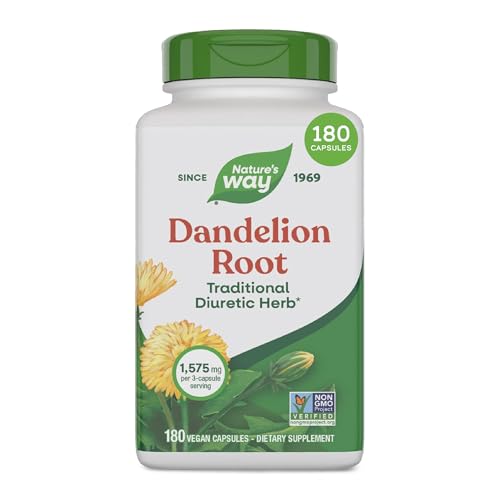
Cost per serving: $$ | 60 servings | 3 capsules per serving
Plain dandelion root powder, with the largest buyer base of any product here.
Quick Stats
- Active ingredient + form: Dandelion root powder in capsules
- Dose per serving: 1,575 mg (3 capsules)
- Dose vs. tradition: At the low end of the 2 to 15 g of dried root a day in the European herbal monograph
- Third-party tested: Not stated on the listing
- Certifications: Non-GMO Project Verified, vegan, gluten-free (label)
- Who should skip: People allergic to ragweed, daisies or other plants in the daisy family, pregnant or breastfeeding women, people with gallstones or bile duct problems, and anyone taking diuretics or diabetes medicines unless their doctor approves
What We Like
It is root itself rather than an extract, so the milligrams on the label are what you get. The label carries its own warning for people allergic to ragweed and related plants. Pattern, the brand’s authorized Amazon seller, sells the listing.
Watch Out For
It takes three capsules a day, the capsules add magnesium stearate, and it is not organic.
What Buyers Report
Buyers frequently mention a noticeable diuretic effect, less bloating and good quality.
About 4 in 10 buyers who mention side effects report problems, mostly heartburn or diarrhea, and about a quarter of effectiveness comments are negative.
Bottom Line: A trusted whole-root capsule at a moderate cost.
5. Oregon’s Wild Harvest Organic Dandelion Root – Simplest Label
Our rating: 4.4/5

Cost per serving: $$$ | 30 servings | 3 capsules per serving
Organic root powder in a pullulan capsule, and nothing else.
Quick Stats
- Active ingredient + form: Organic dandelion root powder in capsules
- Dose per serving: 1,200 mg (3 capsules)
- Dose vs. tradition: Below the 2 to 15 g of dried root a day in the European herbal monograph
- Third-party tested: Non-GMO verified by SGS, an outside lab (label)
- Certifications: Certified organic by Oregon Tilth
- Who should skip: People allergic to ragweed, daisies or other plants in the daisy family, pregnant or breastfeeding women, people with gallstones or bile duct problems, and anyone taking diuretics or diabetes medicines unless their doctor approves
What We Like
The label says the capsule is the only other ingredient, it is made in Oregon, and the brand sells the listing.
Watch Out For
A bottle lasts only a month, so it costs about 72 cents a day, the most here. The buyer base is small.
What Buyers Report
Buyers frequently mention quality and trust in the brand.
The review base is too small to show clear complaints.
Bottom Line: The cleanest whole-root label here, at a higher price.
6. MaryRuth’s Organic Dandelion Root Liquid Extract – Best Liquid
Our rating: 4.3/5

Cost per serving: $$$ | 30 servings | 1 mL per serving
An alcohol-free organic root tincture with a marked dropper.
Quick Stats
- Active ingredient + form: Organic dandelion root liquid extract (1:5), alcohol-free
- Dose per serving: 1 mL (1,180 mg of liquid extract), about 200 mg of dried root by the brand’s figure
- Dose vs. tradition: Lower than the root tinctures in the European herbal monograph (5 to 10 mL, three times a day)
- Third-party tested: The listing shows Clean Label Project certification
- Certifications: USDA Organic, vegan, gluten-free
- Who should skip: People allergic to ragweed, daisies or other plants in the daisy family, pregnant or breastfeeding women, people with gallstones or bile duct problems, and anyone taking diuretics or diabetes medicines unless their doctor approves
What We Like
The label directions allow 1 mL up to three times a day, a buyer notes the dropper is marked in quarter milliliters, and the brand sells the listing. MaryRuth’s and Himalaya scored close, and MaryRuth’s ranks ahead because of its outside contaminant certification.
Watch Out For
A 1-ounce bottle gives a small amount of root per serving, and it costs about 67 cents a serving.
What Buyers Report
Buyers frequently mention quality, a pleasant taste and few side effects.
The main complaint is the small bottle.
Bottom Line: An easy liquid option with outside testing, at a low dose.
7. Himalaya Dandelion Root 1,000 mg – Two-Capsule Option
Our rating: 4.2/5
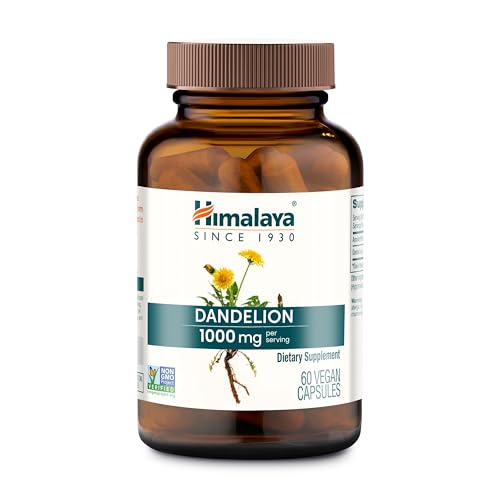
Cost per serving: $$$ | 30 servings | 2 capsules per serving
1,000 mg of dandelion root in two vegan capsules.
Quick Stats
- Active ingredient + form: Dandelion root in vegan capsules
- Dose per serving: 1,000 mg (2 capsules)
- Dose vs. tradition: Below the 2 to 15 g of dried root a day in the European herbal monograph
- Third-party tested: Not stated; one buyer notes the brand tests in its own cGMP facility
- Certifications: Non-GMO Project Verified, vegan (label)
- Who should skip: People allergic to ragweed, daisies or other plants in the daisy family, pregnant or breastfeeding women, people with gallstones or bile duct problems, and anyone taking diuretics or diabetes medicines unless their doctor approves
What We Like
The box warns people allergic to ragweed and related plants not to take it, and the brand sells the listing.
Watch Out For
The listing calls it an extract, but the Supplement Facts panel lists dandelion root without a ratio. A box lasts a month, and the buyer base is small.
What Buyers Report
Buyers mention trust in the brand.
The review base is too small to show clear complaints.
Bottom Line: A simple two-capsule root product from a known herbal brand.
8. Wild & Organic Dandelion Root Extract Drops – Sweet-Tasting Drops
Our rating: 4.1/5

Cost: $$$ (per day, 3 servings) | 171 servings | 0.7 mL per serving
Alcohol-free organic drops that buyers say taste sweet.
Quick Stats
- Active ingredient + form: Organic dandelion root 10:1 extract (Taraxacum mongolicum) in vegetable glycerin
- Dose per serving: 65 mg (0.7 mL), which the brand says equals 650 mg of root
- Dose vs. tradition: Below the 2 to 15 g of dried root a day in the European herbal monograph
- Third-party tested: Not stated; made in a GMP-certified facility (brand claim)
- Certifications: USDA Organic, vegan
- Who should skip: People allergic to soy, ragweed, daisies or other plants in the daisy family, pregnant or breastfeeding women, people with gallstones or bile duct problems, and anyone taking diuretics or diabetes medicines unless their doctor approves
What We Like
Buyers like the taste, and the drops mix into water, tea or coffee. A 4-ounce bottle has about 171 servings, and the brand sells the listing.
Watch Out For
It uses a different dandelion species (Taraxacum mongolicum) from the others here, adds a natural hickory flavor and contains soy. About 4 in 10 buyers who mention the ingredients are unhappy with them, and several mention sediment.
What Buyers Report
Buyers frequently mention a pleasant, sweet taste and an easy routine.
Common complaints are the ingredient list, sediment in the bottle and a few allergic reactions.
Bottom Line: A pleasant-tasting liquid, but a low dose and a longer ingredient list.
Products We Left Out
- Peak Performance Dandelion Root 10:1: A similar 300 mg extract capsule to Zazzee, with a very small buyer base made up mostly of free-product reviews.
- Solaray Dandelion Root: The listing we checked was sold by a seller we could not confirm as authorized by the brand.
- Nutricost Dandelion Extract: The label lists a whole-plant extract of a different species, not root.
- Bronson Dandelion Extract: The label lists a leaf extract.
- Herb Pharm Dandelion: A fresh whole-plant extract (root, leaf and flower) rather than root.
- Teas and cut root: Loose and bagged teas are a different format from the supplements in this guide.
- Blends: Products that mix dandelion with milk thistle, burdock or other herbs are outside this single-ingredient guide.
- NOW, Horbäach and Carlyle: Left out under our brand rules.
Ingredient Breakdown
What Dandelion Root Is
Dandelion root is the taproot of Taraxacum officinale, a plant in the daisy family. It contains bitter compounds, phenolic acids, flavonoids, terpenoids and inulin, a prebiotic fiber, according to MD Anderson Cancer Center. For a dedicated inulin product, see our inulin supplements guide.
Root Powder, Extracts and Tinctures
Root powder capsules contain ground root, so the milligrams on the label are the amount of root. Extracts concentrate the root; a 10:1 extract means the brand used about 10 parts of root to make 1 part of extract. Tinctures are liquid extracts, and their strength depends on the ratio and the dose in milliliters.
What the Research Shows
- Traditional use: The European Medicines Agency monograph recognizes dandelion root for mild digestive complaints such as fullness and gas, temporary loss of appetite, and flushing the urinary tract in minor complaints. It states these uses rest on long-standing use alone.
- Diuretic effect: In a 2009 pilot study of 17 volunteers, a fresh dandelion leaf extract increased how often people urinated after the first dose and the urine-to-fluid ratio after the second dose, over one day. It used leaf, not root.
- Lab and animal studies: A 2006 review described lab and animal findings on bile flow, inflammation, blood sugar and other effects, and noted that they still need to be tested in humans.
- Overall: An MD Anderson integrative medicine physician says there is almost no research on dandelion root in humans, and that claims about cancer are unproven.
How to Take Dandelion Root
- Follow the label: Products here suggest one to three capsules, one scoop of powder, or 1 mL of liquid a day.
- Tea from powder: Mix the powder into hot water; the European monograph describes dried root as a tea taken two to three times a day.
- Before meals for appetite: The monograph suggests taking it half an hour before meals when used for appetite.
- Drink enough fluid: For urinary use, the monograph advises keeping up your fluid intake.
- Short trial first: The monograph says to see a doctor if symptoms last more than two weeks.
Safety, Side Effects & Interactions
- Side effects: Memorial Sloan Kettering Cancer Center lists heartburn, stomach ache, low blood sugar, skin rash and mild diarrhea, which is more likely with high amounts.
- Allergies: MD Anderson says people allergic to ragweed, chrysanthemums or daisies may also react to dandelion. The European monograph lists allergy to the daisy family as a contraindication.
- Gallbladder and liver: The European monograph does not recommend dandelion root with bile duct blockage, gallstones, liver disease or other biliary disease, because it may increase bile flow.
- Medications: Memorial Sloan Kettering notes possible added effects with diuretics and diabetes medicines, and lab findings that dandelion may change how some drugs are broken down. MD Anderson advises asking your doctor if you take blood pressure or blood sugar medicines or certain cancer drugs. If you take a liver support product such as milk thistle, check with your doctor before combining herbs.
- Kidneys and ulcers: MD Anderson advises caution for people with kidney disease or peptic ulcers because of oxalic acid.
- Pregnancy, breastfeeding and children: The European monograph does not recommend use during pregnancy or breastfeeding, or in children under 12, because safety has not been established.
Who Should Avoid It
- People allergic to ragweed, daisies, chrysanthemums or other plants in the daisy family
- People with gallstones, bile duct problems or liver disease, unless their doctor approves
- Pregnant or breastfeeding women
- Children under 12
- People taking diuretics, diabetes medicines or blood pressure medicines, unless their doctor approves
- People with kidney disease or peptic ulcers, unless their doctor approves
How to Choose a Dandelion Root Supplement
Part of the Plant
Check that the Supplement Facts panel says root. Some popular dandelion products contain leaf or the whole plant, which is a different preparation.
Extract Ratio and Root Equivalent
For extracts, look for a ratio such as 10:1 so you can estimate how much root you get. A product that calls itself an extract without a ratio cannot be compared this way.
Organic Certification
MD Anderson advises buying from a reliable source, because dandelions from yards may contain pesticides. Six of the products here are certified organic.
Form
Capsules are convenient; powder costs the least and doubles as a tea; liquids are easy to adjust but give less root per serving.
Cost per Day
Products in this guide cost about 7 to 72 cents a day.
Red Flags on the Label
- Claims to detox, cleanse or repair the liver or kidneys
- “Extract” on the front with no ratio on the Supplement Facts panel
- Leaf or whole plant listed when the front says root
- Blends that hide how much dandelion is in each serving
- Unknown third-party sellers on the listing
Important: These supplements are not intended to diagnose, treat, cure, or prevent any disease. Results vary by individual. If you have a health condition or take medications, check with your doctor before adding any new supplement to your routine.
FAQ
Which dandelion root supplement is best?
In our comparison, PURE CO Organic Dandelion Root 10:1 Extract ranked first because one organic capsule gives the most root by its label, at a low cost per day.
Does dandelion root actually work?
European regulators recognize it for traditional use in mild digestive complaints and as a mild diuretic. Human trials are very limited, and the one small diuretic study used leaf extract.
Is it safe to take dandelion root every day?
The European monograph suggests seeing a doctor if symptoms last more than two weeks. People allergic to daisy-family plants, people with gallstones and anyone on diuretics or diabetes medicines should ask a doctor first.
Is dandelion root a diuretic?
It is used traditionally to increase urine output, and a small one-day study of a leaf extract found more frequent urination. It should not replace prescribed diuretics or blood pressure medicines.
Is dandelion root good for the liver?
Liver benefits come from lab and animal studies, not human trials. The European monograph advises against dandelion root for people with liver disease or gallstones.
What is the difference between dandelion root and dandelion leaf?
The European monograph for the root covers digestion, appetite and urinary flushing, while the only human diuretic study used leaf extract. Check the Supplement Facts panel to see which part a product contains.
Our Take
PURE CO Organic Dandelion Root 10:1 Extract is our top pick among dandelion root supplements because one organic capsule gives the most root by its label, at a low cost per day. Micro Ingredients Organic Dandelion Root Extract Powder is the value pick for a homemade tea, and Nature’s Way Dandelion Root is the whole-root capsule.
Choose Zazzee for a widely reviewed one-a-day extract, Oregon’s Wild Harvest for the simplest organic label, MaryRuth’s for an alcohol-free liquid with outside testing, Himalaya for a two-capsule root product, or Wild & Organic for sweet-tasting drops.
Practical tip: check that the label says root, and for extracts, look for a ratio before you compare milligrams.
Sources
- Taraxacum officinale F.H. Wigg., radix — European Union herbal monograph (2021), European Medicines Agency
- Dandelion — Memorial Sloan Kettering Cancer Center, About Herbs
- Dandelion root: Benefits, side effects and how to try it (2026) — MD Anderson Cancer Center
- The diuretic effect in human subjects of an extract of Taraxacum officinale folium over a single day (2009) — PubMed
- Taraxacum — a review on its phytochemical and pharmacological profile (2006) — PubMed
Labels, sellers and cost tiers last checked: November 18, 2026.
Update log
- November 18, 2026: First published. 8 products compared.


