
| Best Overall | Best Budget | Best Tablet | |
|---|---|---|---|
| Pick | Codeage Wild-Caught Marine Collagen | Micro Ingredients Marine Collagen | Youtheory Marine Collagen Tablets |
| Why | The only marine collagen here with an NSF/ANSI 173 listing we could verify. | The lowest cost per 10 g of collagen in our lineup, with nothing added. | No scooping or mixing, with added vitamins, zinc and selenium. |
| Cost per serving | $$ | $ | $$ |
Quick answer: Of the marine collagen supplements we compared, Codeage Wild-Caught Marine Collagen is the best choice for most people: each 9 g scoop is plain hydrolyzed white-fish collagen, and it is the only product here whose NSF/ANSI 173 certification we could confirm in NSF’s database. If cost matters most, Micro Ingredients Marine Collagen gives you 12 g per serving for the lowest cost per 10 g. The research on skin is mixed: pooled trials show modest gains, but the independent, higher-quality studies do not.
Marine collagen supplements are hydrolyzed collagen peptides made from fish skin or scales, and the labels make them hard to compare. A “serving” can be a 1 g capsule dose or a 12 g scoop, the fish species is often missing, and “wild-caught” or “tested” claims rarely come with proof.
We looked at grams of collagen per serving, the fish source, other ingredients, verified testing, recent recalls, who sells the product, and cost per 10 g of collagen. We scored each product using our how we test criteria. Every product here made our shortlist, and our ratings show how they rank against each other.
Skin trials pooled in a 2023 meta-analysis used anywhere from about 0.6 g to 12 g of collagen a day, usually for 8 to 12 weeks, so a powder that delivers a full dose in one scoop is usually better value than a few capsules.
Comparison Table
| Rank | Product | Form | Dose | Cost/Serving | Third-Party Tested | Best For |
|---|---|---|---|---|---|---|
| 1 | Codeage Wild-Caught Marine Collagen | Powder | 9 g per scoop | $$ | Yes | Best Overall |
| 2 | Amandean Marine Collagen Peptides | Powder | 10 g per scoop | $ | Not stated | Best Large Tub |
| 3 | Sports Research Marine Collagen Peptides | Powder | 10 g per scoop | $$ | Not stated | Best Everyday Pick |
| 4 | Micro Ingredients Marine Collagen | Powder | 12 g per 2 scoops | $ | Not stated | Best Budget |
| 5 | Vital Proteins Marine Collagen | Powder | 12 g per 3 Tbsp | $$ | Not stated | Best Known Brand |
| 6 | Orgain Wild-Caught Marine Collagen | Powder | 12 g per scoop | $$ | Not stated | Best Pollock-Sourced |
| 7 | Further Food Marine Collagen | Powder | 12 g per scoop | $$$ | Not stated | Best Small Tub |
| 8 | Youtheory Marine Collagen Tablets | Tablet | 2.5 g per 5 tablets | $$ | Not stated | Best Tablet |
Cost tiers per 10 g of collagen: $ under $1.00 · $$ $1.00–$1.60 · $$$ over $1.60 (checked November 2026).
In-Depth Reviews: Top 8 Marine Collagen Supplements of 2026
1. Codeage Wild-Caught Marine Collagen – Best Overall
Our rating: 4.8/5
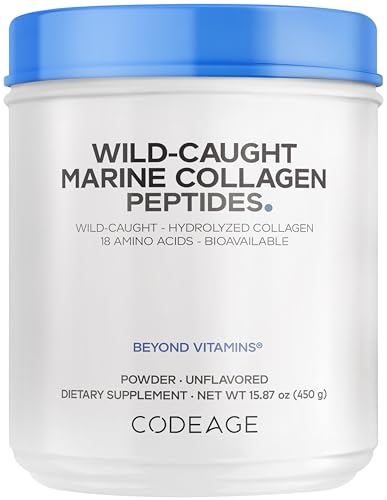
Cost: $$ (per 10 g collagen) | 50 servings | 1 scoop (9 g) per serving
Plain white-fish collagen with an NSF certification we could confirm.
Quick Stats
- Active ingredient + form: Hydrolyzed wild-caught, cold-water white fish collagen; no other ingredients listed
- Dose per serving: 9 g (9,000 mg) collagen
- Dose vs. research: Within studied range (skin trials used about 0.6 to 12 g a day)
- Third-party tested: Yes (NSF/ANSI 173 listing for Wild-Caught Marine Collagen Peptides, 1 scoop of 9 g, checked November 2026)
- Certifications: NSF/ANSI 173; made in a cGMP-certified facility; non-GMO, gluten-free, dairy-free
- Who should skip: People with a fish allergy
What We Like
The label lists 9 g of white-fish collagen and nothing else, and NSF’s public database lists this exact product and serving size under its dietary supplement standard. That is a stronger check than the unnamed “third-party tested” claims on most tubs.
A 50-serving tub lasts close to two months, and it is sold by the brand.
Watch Out For
At 9 g it is slightly below the 10 to 12 g scoops of some rivals, and the label does not name the fish species beyond “white fish.” Some buyers notice a fishy smell.
What Buyers Report
Buyers frequently mention that it has no taste, dissolves quickly in hot drinks and mixes well into coffee, smoothies and baking. Many report better-looking hair, skin and nails, and some mention more comfortable joints.
Smell is the main split: some find it odorless, while a smaller group notices a fishy smell. A minority dislike the taste.
Bottom Line: The marine collagen we would pick first, because its quality claim is backed by an independent certifier.
2. Amandean Marine Collagen Peptides – Best Large Tub
Our rating: 4.7/5

Cost: $ (per 10 g collagen) | 50 servings | 1 scoop (10 g) per serving
A 500 g tub of plain fish collagen at a low cost per 10 g.
Quick Stats
- Active ingredient + form: Hydrolyzed fish collagen from wild-caught deep-sea fish; no other ingredients
- Dose per serving: 10 g collagen
- Dose vs. research: Within studied range
- Third-party tested: Not stated (the brand says it is third-party lab tested but names no lab)
- Certifications: Non-GMO
- Who should skip: People with a fish allergy
What We Like
Each scoop delivers 10 g of collagen with nothing else added, and the cost per 10 g is one of the lowest here. It has by far the largest base of buyer feedback among the powders, and it is sold by the brand.
Watch Out For
No lab is named for its testing claim, and buyers often say it clumps in cold drinks. A sizable minority notice a fishy smell.
What Buyers Report
Buyers frequently mention that it works well for them, has no taste and mixes easily into coffee and smoothies. Many report smoother skin and stronger nails, some report less joint discomfort, and several like it as an alternative to bovine collagen.
Mixing is the main complaint: plenty say it does not dissolve well in cold liquids. Smell gets mixed feedback, with a noticeable share describing it as fishy.
Bottom Line: A well-reviewed, low-cost 10 g scoop if you mix it into something warm.
3. Sports Research Marine Collagen Peptides – Best Everyday Pick
Our rating: 4.6/5

Cost: $$ (per 10 g collagen) | 34 servings | 1 scoop (10 g) per serving
A single-ingredient 10 g scoop that names its fish species.
Quick Stats
- Active ingredient + form: Hydrolyzed marine collagen peptides from barramundi and/or red snapper; no other ingredients
- Dose per serving: 10 g collagen
- Dose vs. research: Within studied range
- Third-party tested: Not stated (the brand says it is third-party quality tested but names no lab)
- Certifications: Non-GMO, keto certified, paleo friendly
- Who should skip: People with a fish allergy
What We Like
The label names the fish species, which most rivals do not, and lists collagen as the only ingredient. Buyers say it dissolves quickly in both hot and cold drinks, and it is sold by the brand.
Watch Out For
It costs a little more per 10 g than Amandean, which is why it ranks third despite an identical score on the other criteria. Sports Research is listed with NSF as a company, but we found no NSF listing for this collagen.
What Buyers Report
Buyers frequently mention that it works well, dissolves quickly hot or cold and mixes easily into smoothies and coffee. Several report more comfortable knees and hips.
Value gets mixed feedback, with some saying it doesn’t live up to the claims. It is not completely tasteless for everyone, a group notices an unpleasant smell, and a few mention clumps.
Bottom Line: An easy-mixing, clearly sourced powder for daily use.
4. Micro Ingredients Marine Collagen – Best Budget
Our rating: 4.5/5

Cost: $ (per 10 g collagen) | 37 servings | 2 scoops (12 g) per serving
The lowest cost per 10 g of collagen in our lineup.
Quick Stats
- Active ingredient + form: Hydrolyzed marine collagen peptides from whitefish; no other ingredients
- Dose per serving: 12 g collagen
- Dose vs. research: Within studied range
- Third-party tested: Not stated (the brand says each batch is third-party lab tested but names no lab)
- Certifications: Non-GMO; made without soy, dairy, gluten and tree nuts
- Who should skip: People with a fish allergy, or anyone avoiding products with a California Proposition 65 warning
What We Like
Two scoops give you 12 g of collagen, and the cost per 10 g is the lowest we found. The label lists nothing but marine collagen peptides.
Watch Out For
The pouch carries a California Proposition 65 warning, which means the product contains a listed chemical above that state’s threshold; the label does not say which one. Some buyers report stomach upset.
What Buyers Report
Buyers frequently mention stronger nails and better-looking skin, easy dissolving in hot or cold liquids, the short ingredient list and good value. Most find it tasteless.
Side effects are the main split: a noticeable share report stomach issues. A smaller group finds the smell or taste strongly fishy, and a few say it clumps.
Bottom Line: The cheapest way to get a full daily dose of plain marine collagen.
5. Vital Proteins Marine Collagen – Best Known Brand
Our rating: 4.4/5

Cost: $$ (per 10 g collagen) | about 18 servings | 3 tablespoons (12 g) per serving
Cod-sourced collagen from the best-known collagen brand.
Quick Stats
- Active ingredient + form: Collagen peptides from cod
- Dose per serving: 12 g collagen
- Dose vs. research: Within studied range
- Third-party tested: Not stated (NSF lists several Vital Proteins bovine collagen products, but not this marine collagen)
- Certifications: Non-GMO Project Verified, gluten-free
- Who should skip: People with a fish allergy; the label also notes it is made in a facility that processes milk
What We Like
The label is simple, the fish is named, and the brand has by far the largest base of buyer feedback for marine collagen. It dissolves well, especially in hot coffee, and it is sold by the brand.
Watch Out For
The canister holds only about 18 servings, and many buyers feel it is poor value. A large group complains the container arrives half full; powder is sold by weight and settles, so check the net weight rather than the fill line. Its NSF listings cover bovine collagen, not this product.
What Buyers Report
Buyers frequently mention that it has no taste, dissolves well and helps their skin, hair and nails after about two months.
Value is the most common complaint, along with containers that look half full. Joint results are mixed, and some report digestive discomfort.
Bottom Line: A trusted, clearly sourced formula, but you pay more per 10 g than for #1 to #4.
6. Orgain Wild-Caught Marine Collagen – Best Pollock-Sourced
Our rating: 4.3/5

Cost: $$ (per 10 g collagen) | about 20 servings | 1 scoop (12 g) per serving
Alaskan pollock collagen sold and shipped by Amazon.
Quick Stats
- Active ingredient + form: Collagen peptides from wild-caught Alaskan pollock
- Dose per serving: 12 g collagen
- Dose vs. research: Within studied range
- Third-party tested: Not stated (the label shows non-GMO and B Corp badges, but no named testing lab for this product)
- Certifications: Non-GMO tested, gluten-free, no soy, paleo friendly; Certified B Corporation
- Who should skip: People with a fish allergy
What We Like
The label names the fish and the source region, and a 12 g scoop sits squarely in the studied range. This listing is sold by Amazon.
Watch Out For
In December 2024 Orgain recalled one lot of a plant-based chocolate protein powder because of undeclared peanut, an FDA Class I recall. The recall did not involve collagen, but it lowered the brand’s testing score in our ranking. Its review base is still small.
What Buyers Report
Buyers frequently mention that it mixes well, including in cold drinks and smoothies, and some report better skin and less joint discomfort.
Taste splits buyers, with some calling it awful, and a few find it expensive for the size.
Bottom Line: A good pollock-based scoop with a short track record on this listing.
7. Further Food Marine Collagen – Best Small Tub
Our rating: 4.2/5

Cost: $$$ (per 10 g collagen) | about 14 servings | 1 scoop (12 g) per serving
A small tub of single-ingredient fish collagen.
Quick Stats
- Active ingredient + form: Hydrolyzed fish collagen peptides (types I, II and III listed on the amino acid panel)
- Dose per serving: 12 g collagen
- Dose vs. research: Within studied range
- Third-party tested: Not stated
- Certifications: None shown on the label we reviewed
- Who should skip: Budget buyers; it is the most expensive powder here per 10 g
What We Like
The ingredient list is a single line, and the small tub is an easy way to try marine collagen before committing to a large one. It is sold by the brand.
Watch Out For
It costs the most per 10 g among the powders, the label does not name the fish species, and we found no testing claim. Buyers often complain the tub looks half full.
What Buyers Report
Some buyers report better skin and no side effects, and a few call it the best they have tried.
Results are mixed overall, the taste is fishy for some, and many say the container looks half full and is not worth the price. The review base is small.
Bottom Line: Fine for a trial run, but the top four give you more collagen for less.
8. Youtheory Marine Collagen Tablets – Best Tablet
Our rating: 4.1/5

Cost: $$ (per 10 g collagen) | 58 servings | 5 tablets (2.5 g) per serving
Marine collagen in tablets, with a small vitamin and mineral blend.
Quick Stats
- Active ingredient + form: Hydrolyzed fish collagen in tablets, plus vitamins A, C, E, B6 and B12, zinc, selenium and silica
- Dose per serving: 2.5 g (2,500 mg) collagen per 5 tablets
- Dose vs. research: Within studied range at the low end (2.5 g)
- Third-party tested: Not stated (the brand says it is third-party tested but names no lab)
- Certifications: Made in the brand’s GMP-certified facility
- Who should skip: Anyone who has trouble swallowing large tablets; people already taking a multivitamin should count the extra vitamin A and zinc
What We Like
It is the only option here that needs no mixing, and 2.5 g matches the lower dose used in some skin trials. The 290-count bottle lasts almost two months.
Watch Out For
You need five large tablets to reach 2.5 g, a quarter of a typical powder scoop. On Amazon it is sold by Pattern, a third-party seller, rather than the brand. One listing image mentions ceramides, but the Supplement Facts panel we read does not list them, so check the bottle you receive.
What Buyers Report
Buyers frequently mention good quality, glowing skin and faster hair and nail growth, and they like not having to mix a powder.
Tablet size is the most common complaint, and many find them hard to swallow. Digestion, results and value all get mixed feedback.
Bottom Line: The pick if you won’t use a powder, but expect to swallow five tablets a day for a modest dose.
Ingredient Breakdown
Hydrolyzed Marine Collagen
Marine collagen is mostly type I collagen taken from fish skin or scales and broken down (hydrolyzed) into small peptides that mix into drinks. Trials of hydrolyzed collagen for skin used doses from about 1 g of specialized low-molecular-weight fish collagen (Kim 2018) to 2.5 to 5 g of collagen hydrolysate for 8 weeks (Proksch 2014), and most products here deliver 9 to 12 g per scoop.
What the Research Shows for Skin
A 2021 meta-analysis of 19 trials (1,125 participants, mostly women) found improvements in skin hydration, elasticity and wrinkles after about 90 days (de Miranda 2021), and a 2023 analysis of 26 trials reached a similar conclusion while noting several sources of bias (Pu 2023).
A 2025 meta-analysis of 23 trials looked closer: studies funded by supplement companies showed benefits, but studies without that funding, and the higher-quality studies, showed no significant effect on hydration, elasticity or wrinkles (Myung 2025). The honest summary is that any skin benefit is modest and not yet confirmed by independent research.
Marine vs. Bovine Collagen
There is little head-to-head research. In the 2023 analysis, the source of collagen did not make a significant difference to skin elasticity, though results for hydration varied by source (Pu 2023). Choose marine collagen if you prefer a fish source or avoid beef and pork, not because it is proven to work better. For beef-based powders, see our collagen peptides guide.
Collagen for Joints
A 2019 meta-analysis of collagen supplements, which pooled several types of collagen, found lower osteoarthritis symptom scores than placebo for total WOMAC and pain scale scores, but not for the pain or function subscores (García-Coronado 2019). If joints are your main goal, our guide to the best glucosamine supplements covers another option with its own mixed evidence.
How to Take Marine Collagen
Take one serving a day, at any time; stir it into coffee, tea, a smoothie or oatmeal. Warm liquids dissolve it best, and several buyers report clumps in cold water.
Give it at least 8 to 12 weeks before judging the effect on skin, the length of most trials. Collagen is not a complete protein, so it should not replace the protein in your meals; for older adults focused on muscle, see our leucine supplements guide. If you are also considering biotin for hair and nails, our biotin supplements guide compares sensible doses.
Safety, Side Effects & Interactions
Hydrolyzed collagen is generally well tolerated in trials; the 2014 and 2018 skin studies reported no side effects related to the supplement (Proksch 2014, Kim 2018). Some buyers report stomach upset, bloating or a fishy aftertaste.
- Fish allergy: Fish is one of the nine major food allergens in the U.S. (FDA), and every product here is made from fish.
- Protein-restricted diets: Each powder scoop adds about 9 to 11 g of protein; people with kidney disease who are told to limit protein should ask their doctor first.
- Added vitamins: Tablets with vitamin A and zinc add to what you get from a multivitamin.
- Medications: We found no well-documented drug interactions for collagen peptides in the trials we reviewed, but ask your pharmacist if you take prescription medicines.
Who Should Avoid It
- People with a fish allergy
- People on a protein-restricted diet, unless their doctor approves
- Pregnant or breastfeeding women, unless their doctor approves
- Children, unless a doctor recommends it
How to Choose Marine Collagen Supplements
Form and Bioavailability
Look for “hydrolyzed collagen” or “collagen peptides,” which dissolve in drinks. Powders deliver a full dose in one scoop; tablets and capsules need several pills for a fraction of that amount.
Dosage – What to Look For
Check the grams of collagen per serving, not the bottle count. Skin trials used about 0.6 to 12 g a day, and the lowest doses were usually specific branded ingredients, so a generic 1 g capsule dose is on the low side.
Third-Party Testing
NSF/ANSI 173 or NSF Certified for Sport listings can be checked in NSF’s public database. In November 2026 we found an NSF listing for Codeage’s marine collagen only; most other brands say “third-party tested” without naming a lab.
Cost Per Serving vs. Cost Per Bottle
Compare cost per 10 g of collagen. A capsule bottle can look cheap per serving while costing far more per gram than a powder.
Red Flags on the Label
- No grams of collagen listed per serving
- “Proprietary blend” collagen with added actives in undisclosed amounts
- Fish species or source not named at all
- Testing claims with no lab or certifier named
- Disease claims such as reversing arthritis or curing wrinkles
Important: These supplements are not intended to diagnose, treat, cure, or prevent any disease. Results vary by individual. If you have a health condition or take medications, check with your doctor before adding any new supplement to your routine.
FAQ
Is marine collagen better than bovine collagen?
There is no strong evidence that it works better. Pooled trials found no significant difference by source for skin elasticity; marine collagen mainly suits people who prefer a fish source.
How much marine collagen should I take a day?
Skin trials used anywhere from about 0.6 to 12 g a day, often for 8 to 12 weeks. One scoop of the powders here provides 9 to 12 g.
How long does marine collagen take to work?
Trials usually measured skin changes after 8 to 12 weeks. Some higher-quality independent trials found no clear effect, so results are not guaranteed.
Can I put marine collagen in hot coffee?
Yes. Hydrolyzed collagen dissolves well in hot drinks, and buyers say it mixes most easily that way.
Is marine collagen safe if I’m allergic to fish?
No. Marine collagen is made from fish, and fish is a major food allergen, so people with a fish allergy should avoid it.
Is marine collagen a complete protein?
No. Collagen is an incomplete protein, as labels such as Vital Proteins’ point out, so count it as a supplement, not a replacement for protein foods.
Our Take
Codeage Wild-Caught Marine Collagen is our top pick among marine collagen supplements because it pairs a plain 9 g scoop with an NSF listing we could verify. Amandean Marine Collagen Peptides and Sports Research Marine Collagen Peptides are close behind, Micro Ingredients Marine Collagen is the budget choice, and Youtheory Marine Collagen Tablets suit people who won’t use a powder.
Practical tip: stir your scoop into a warm drink, take it daily for three months, then decide whether it is worth continuing.
Sources
- Effects of hydrolyzed collagen supplementation on skin aging: a systematic review and meta-analysis (2021) — PubMed
- Effects of Oral Collagen for Skin Anti-Aging: A Systematic Review and Meta-Analysis (2023) — PubMed
- Effects of Collagen Supplements on Skin Aging: A Systematic Review and Meta-Analysis of Randomized Controlled Trials (2025) — PubMed
- Oral supplementation of specific collagen peptides has beneficial effects on human skin physiology (2014) — PubMed
- Oral Intake of Low-Molecular-Weight Collagen Peptide Improves Hydration, Elasticity, and Wrinkling in Human Skin (2018) — PubMed
- Effect of collagen supplementation on osteoarthritis symptoms: a meta-analysis of randomized placebo-controlled trials (2019) — PubMed
- Food Allergies: What You Need to Know — FDA
- NSF/ANSI 173 Dietary Supplements listing: Codeage LLC — NSF
Labels, sellers and cost tiers last checked: November 4, 2026.
Update log
- November 10, 2026: Added a link to our new collagen peptides guide. No product or ranking changes.
- November 9, 2026: Added a link to our new biotin supplements guide.
- November 4, 2026: First published. 8 products compared.


