
| Best Overall | Best Pure Powder | Best Value | |
|---|---|---|---|
| Pick | Yerba Prima Psyllium Whole Husks | Konsyl Daily Psyllium Fiber | NOW Psyllium Husk Powder |
| Why | 100% whole psyllium husks with nothing added, from a brand that has made them for over 40 years. | Single-ingredient powder that is NSF/ANSI 173 certified, verified on the NSF listing. | 7 g of fiber per serving, 6 g of it soluble, at the lowest cost per gram of fiber in our lineup. |
| Cost per 5 g fiber | $$ | $$ | $ |
Quick answer: Of the psyllium husk supplements we compared, Yerba Prima Psyllium Whole Husks is our top pick for most people: it is nothing but whole psyllium husks, with no sweeteners or fillers, at a moderate cost. Konsyl Daily Psyllium Fiber is the only product here with a verified third-party certification (NSF/ANSI 173), and NOW Psyllium Husk Powder is the best value. Psyllium can contain trace lead, so most labels in this category carry a California Prop 65 warning; we note it for every product.
Psyllium husk supplements are made from the seed coat of Plantago ovata, a plant grown mainly in India. The husk is rich in soluble fiber that forms a gel in water, which is why psyllium is used for regularity, cholesterol and feeling full.
Products differ less in the plant than in the details: whole husk or powder, how much fiber and soluble fiber a serving gives, added sweeteners and flavors, outside testing, and cost per gram of fiber.
We compared those factors and scored each product using our how we test criteria. Every product here made our shortlist, and our ratings show how they rank against each other.
Lead is a real issue for this category. In ConsumerLab’s 2024 testing, 4 of 9 psyllium products were contaminated with excessive lead (ConsumerLab). We list each product’s Prop 65 warning and any outside certification below.
Comparison Table
| Rank | Product | Form | Dose | Cost/5 g Fiber | Third-Party Tested | Best For |
|---|---|---|---|---|---|---|
| 1 | Yerba Prima Psyllium Whole Husks | Whole husks | 5 g: 4 g fiber (3 g soluble) | $$ | Not stated | Best Overall |
| 2 | Konsyl Daily Psyllium Fiber | Powder | 6 g: 5 g fiber (3 g soluble) | $$ | Yes (NSF/ANSI 173) | Best Pure Powder |
| 3 | NOW Psyllium Husk Powder | Powder | 9 g: 7 g fiber (6 g soluble) | $ | Not stated | Best Value |
| 4 | Metamucil 4-in-1 Sugar-Free | Flavored powder | 11.6 g: 6 g fiber (5 g soluble) | $$ | Not stated | Best Flavored |
| 5 | Viva Naturals Organic Psyllium Husk Powder | Organic powder | 5 g: 4 g fiber (4 g soluble) | $$ | Not stated | Best Organic Powder |
| 6 | Anthony’s Organic Psyllium Husk Powder | Organic powder | 4 g: 3 g fiber | $$ | Not stated (batch tested gluten-free) | Best for Baking |
| 7 | Micro Ingredients Organic Psyllium Husk Powder | Organic powder | 5 g: 4 g fiber | $ | Not stated (brand claims third-party lab testing) | Best Bulk Organic |
| 8 | Nutricost Psyllium Husk 1,500 mg | Capsules | 3 capsules (1.5 g): 1 g fiber | $$$ | Not stated (brand claims third-party testing) | Best Capsule |
Cost tiers per 5 g of fiber: $ under $0.25 · $$ $0.25–$0.40 · $$$ over $0.40 (checked November 2026).
In-Depth Reviews: Top 8 Psyllium Husk Supplements of 2026
1. Yerba Prima Psyllium Whole Husks – Best Overall
Our rating: 4.8/5

Cost: $$ (per 5 g fiber) | 68 servings | 1 tablespoon (5 g) per serving
Plain whole psyllium husks, the simplest form of this supplement, from a long-established maker.
Quick Stats
- Active ingredient + form: Psyllium seed husks, whole (not ground)
- Dose per serving: 5 g husks: 4 g fiber (3 g soluble, 1 g insoluble)
- Dose vs. research: 1 to 3 servings a day (label) covers the 10 g/day used in cholesterol and constipation trials at the top end
- Third-party tested: Not stated (the listing says “tested for purity”; no outside certificate named)
- Certifications: Non-GMO Project Verified, gluten-free; label carries a California Prop 65 lead warning
- Who should skip: Anyone with difficulty swallowing; people who dislike a grainy texture
What We Like
The label lists one ingredient and nothing else: no sweeteners, flavors or fillers. The instructions are clear: mix for a few seconds, drink right away and follow with water. Buyers report strong results for regularity at a moderate cost per serving.
Watch Out For
The 2025 label carries a California Prop 65 warning for lead, and Yerba Prima names no outside lab, unlike Konsyl (#2). It is sold on Amazon by a third-party seller, Peak10 Health, and shipped by Amazon. Whole husks have a grainy texture that some buyers dislike.
What Buyers Report
Buyers frequently mention reliable regularity, help with loose stools and gut comfort, and appreciate that it contains no sugar or artificial sweeteners.
Taste and mixing get mixed reviews, with some saying the husks don’t dissolve well in water.
Bottom Line: The most straightforward psyllium supplement we found: one ingredient, clear directions and good results, but with a Prop 65 lead warning and no outside certification.
2. Konsyl Daily Psyllium Fiber – Best Pure Powder
Our rating: 4.7/5

Cost: $$ (per 5 g fiber) | 90 servings | 1 teaspoon (6 g) per serving
The only product in our lineup with a third-party certification we could verify.
Quick Stats
- Active ingredient + form: Powdered psyllium husks
- Dose per serving: 6 g powder: 5 g fiber (3 g soluble)
- Dose vs. research: 1 to 3 teaspoons a day (label) covers the 10 g/day used in trials
- Third-party tested: Yes. Daily Psyllium Fiber is listed under NSF/ANSI 173 on the NSF certified products database (checked November 3, 2026)
- Certifications: NSF/ANSI 173; label carries a California Prop 65 lead warning
- Who should skip: Children under 6 unless a doctor advises it (label)
What We Like
NSF/ANSI 173 certification means an independent body checks that the product matches its label and stays within contaminant limits, which matters for an ingredient prone to lead. It is a single ingredient, sold by Konsyl Pharmaceuticals, and gives more fiber per teaspoon than most powders here.
Watch Out For
The label still carries a California Prop 65 lead warning, so certification doesn’t mean lead-free. Buyers often complain that it clumps and tastes bad, and it costs a little more per gram of fiber than NOW (#3).
What Buyers Report
Buyers who like it say it dissolves quickly and feels smooth rather than gritty.
Taste and mixing are the most common complaints, with many reporting clumping and an unpleasant taste.
Bottom Line: The best-verified psyllium in our lineup, held back by mixing complaints.
3. NOW Psyllium Husk Powder – Best Value
Our rating: 4.6/5

Cost: $ (per 5 g fiber) | about 38 servings | 1 level tablespoon (9 g) per serving
The most fiber per serving and the lowest cost per gram of fiber here.
Quick Stats
- Active ingredient + form: Psyllium seed husk powder
- Dose per serving: 9 g powder: 7 g fiber (6 g soluble, 1 g insoluble)
- Dose vs. research: One serving gives 6 g of the 7 g of soluble fiber from psyllium in the FDA heart-health claim
- Third-party tested: Not stated (NOW says it is packaged and quality tested in the USA)
- Certifications: Non-GMO Project Verified; manufacturing GMP-certified by Intertek; label carries a California Prop 65 lead warning
- Who should skip: Anyone who needs a pre-flavored product to drink it
What We Like
One level tablespoon gives 7 g of fiber, more than any other single serving here, and the 12 oz size is sold by Amazon at a very low price. The label uses the FDA-approved heart-health claim correctly and tells you to start low and build up.
Watch Out For
The listing carries a California Prop 65 lead warning. The 24 oz size often has no Amazon offer, so the 12 oz bag is usually the better buy. Like most unflavored powders, it clumps if it sits.
What Buyers Report
Buyers frequently mention that it works well for constipation, often better than branded fiber, and appreciate the high fiber per tablespoon.
Taste and dissolving are mixed, with some reporting clumping and an earthy aftertaste.
Bottom Line: The best fiber for the money, with the same lead caveat as most of the category.
4. Metamucil 4-in-1 Sugar-Free – Best Flavored
Our rating: 4.5/5

Cost: $$ (per 5 g fiber) | about 90 servings | 2 rounded teaspoons (11.6 g) per serving
The easiest psyllium to drink, thanks to orange flavor and sweetener.
Quick Stats
- Active ingredient + form: Psyllium husk with maltodextrin, citric acid, orange flavor, aspartame and Yellow 6
- Dose per serving: 11.6 g powder: 6 g fiber (5 g soluble)
- Dose vs. research: Within studied range at the label dose
- Third-party tested: Not stated
- Certifications: None stated
- Who should skip: People with phenylketonuria (it contains aspartame); anyone avoiding artificial sweeteners or dyes
What We Like
It mixes and tastes better than unflavored powders, which helps people stick with it, and buyers rate the orange flavor highly. It is sold and shipped by Amazon.
Watch Out For
The formula adds maltodextrin, aspartame and Yellow 6. ConsumerLab reports that Metamucil 4-in-1 had lead contamination in its 2021 testing, and that a lawsuit alleged Procter & Gamble failed to disclose lead in some Metamucil products (ConsumerLab).
What Buyers Report
Buyers frequently mention a pleasant orange taste, good results for constipation and good value.
Several dislike the artificial ingredients, especially aspartame and maltodextrin.
Bottom Line: The most drinkable option, if you accept the sweetener, dye and extra ingredients.
5. Viva Naturals Organic Psyllium Husk Powder – Best Organic Powder
Our rating: 4.4/5

Cost: $$ (per 5 g fiber) | about 56 servings | 1 teaspoon (5 g) per serving
A finely milled organic powder with almost all of its fiber in soluble form.
Quick Stats
- Active ingredient + form: Organic psyllium husk powder
- Dose per serving: 5 g powder: 4 g fiber (4 g soluble, less than 1 g insoluble)
- Dose vs. research: About 2 to 3 teaspoons a day reaches the 10 g/day used in trials
- Third-party tested: Not stated
- Certifications: USDA Organic (certified by QAI), Non-GMO; listing carries a California Prop 65 lead warning
- Who should skip: People with soy, mustard or sesame allergies (label says it may contain them)
What We Like
The fine grind mixes into smoothies and baking easily, and the label shows a high share of soluble fiber. It is sold by Viva Naturals directly and has a very large base of buyer feedback.
Watch Out For
The listing carries a California Prop 65 lead warning, and no outside certification is named. The label notes possible soy, mustard and sesame from the facility.
What Buyers Report
Buyers frequently mention that it keeps them regular and works better than branded fiber for some.
Texture and dissolving get mixed reviews, with some finding it fine and others too chunky.
Bottom Line: A good organic powder for smoothies, with the usual lead caveat and allergen note.
6. Anthony’s Organic Psyllium Husk Powder – Best for Baking
Our rating: 4.3/5

Cost: $$ (per 5 g fiber) | 170 servings | 1 teaspoon (4 g) per serving
A large bag of organic powder that many buyers use in low-carb and gluten-free baking.
Quick Stats
- Active ingredient + form: Organic psyllium husk powder
- Dose per serving: 4 g powder: 3 g fiber
- Dose vs. research: About 3 teaspoons a day reaches the 10 g/day used in trials
- Third-party tested: Not stated (batch tested and verified gluten-free)
- Certifications: USDA Organic, gluten-free, non-GMO
- Who should skip: Anyone who wants a supplement-style label with soluble fiber listed
What We Like
The 1.5 lb bag lasts a long time, it is sold by Anthony’s directly, and the fine powder works well as a binder in bread. Batch testing for gluten is a plus for people with celiac disease.
Watch Out For
The nutrition panel lists only total fiber (3 g per teaspoon), not soluble fiber, and there is no outside contaminant certification.
What Buyers Report
Buyers frequently mention good results in smoothies, better regularity and good value.
Opinions are split on mixing in water, grittiness and taste.
Bottom Line: The pick for bakers and big-bag buyers, with fewer label details than the supplements above.
7. Micro Ingredients Organic Psyllium Husk Powder – Best Bulk Organic
Our rating: 4.2/5
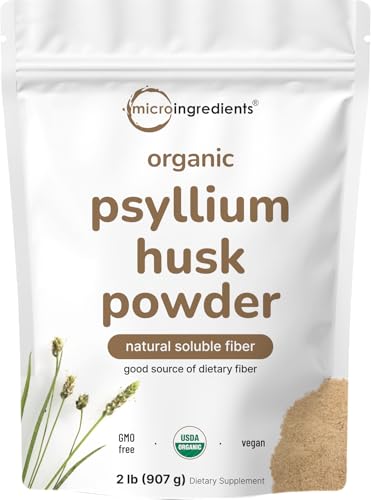
Cost: $ (per 5 g fiber) | 181 servings | 1 scoop (5 g) per serving
The lowest-cost organic powder in our lineup, in a 2 lb pouch.
Quick Stats
- Active ingredient + form: Organic psyllium husk powder
- Dose per serving: 5 g powder: 4 g fiber
- Dose vs. research: About 2 to 3 scoops a day reaches the 10 g/day used in trials
- Third-party tested: Not stated (the listing shows a “third party lab tested” badge but names no lab)
- Certifications: USDA Organic, cGMP, non-GMO
- Who should skip: Anyone who wants detailed directions on the package
What We Like
You get organic psyllium at a cost per gram of fiber close to NOW (#3), with a scoop included.
Watch Out For
One buyer reports a Prop 65 lead warning on the package, and the testing badge names no lab. It is sold by Bayland Health, whose NatureBell brand received a 2025 Prop 65 notice over lead in other products (California Attorney General).
What Buyers Report
Buyers frequently mention good value, steady regularity and feeling fuller.
Mixing is the main complaint: several say it lumps in water and thickens fast.
Bottom Line: Cheap organic psyllium in bulk, with less testing transparency than the top picks.
8. Nutricost Psyllium Husk 1,500 mg – Best Capsule
Our rating: 4.0/5

Cost: $$$ (per 5 g fiber) | 167 servings | 3 capsules (1.5 g) per serving
The capsule pick for people who can’t stand the texture of psyllium drinks.
Quick Stats
- Active ingredient + form: Psyllium husk powder in hypromellose capsules, with rice flour
- Dose per serving: 3 capsules: 1,500 mg psyllium, 1 g fiber
- Dose vs. research: Well below studied doses at the label serving; you would need many capsules to reach 10 g of psyllium
- Third-party tested: Not stated (the brand says “third party tested” but names no lab)
- Certifications: GMP-compliant facility, non-GMO, gluten-free
- Who should skip: Anyone using psyllium for cholesterol or constipation, unless they will take many capsules a day
What We Like
Capsules avoid the texture and taste problems of powders, the bottle holds 500 capsules, and buyers find them easy to swallow.
Watch Out For
Three capsules give only 1 g of fiber, so matching one tablespoon of NOW (#3) would take about 20 capsules. The label is for adults 18 and older.
What Buyers Report
Buyers frequently mention easy swallowing and good value.
Results are mixed, with some noticing little effect, and a few object that it isn’t 100% psyllium.
Bottom Line: Convenient, but a weak dose per serving; powders are a better fit for most goals.
Ingredient Breakdown
Psyllium Husk (Plantago ovata)
Psyllium husk is mostly soluble fiber that forms a gel in water, which softens stool and adds bulk.
In a 2018 meta-analysis of 28 trials and 1,924 participants, a median of about 10 g of psyllium a day lowered LDL cholesterol by 0.33 mmol/L, about 13 mg/dL (Jovanovski 2018). The FDA allows a heart-health claim for foods that provide soluble fiber from psyllium husk, based on 7 g or more a day as part of a diet low in saturated fat and cholesterol (21 CFR 101.81).
For chronic constipation, a 2022 meta-analysis of 16 trials found fiber supplements helped more people than placebo (66% vs. 41%), with psyllium among the fibers that worked. The benefit appeared mainly at doses above 10 g a day taken for at least 4 weeks (van der Schoot 2022). The American College of Gastroenterology recommends soluble fiber such as psyllium, but not wheat bran, for overall IBS symptoms (Lacy 2021).
Lead in Psyllium
In ConsumerLab’s 2024 testing, 4 of 9 psyllium products contained excessive lead, up to 8.5 mcg per 4 g of fiber, while the cleanest had 1 mcg or less per serving (ConsumerLab). A California Prop 65 warning means a daily serving may exceed California’s very low lead warning level; it is a California disclosure rule, not a federal safety limit.
Sweeteners, Flavors and Fillers
Flavored products like Metamucil add maltodextrin, sweeteners and dyes. Capsules add a shell and sometimes rice flour. Unflavored powders and whole husks are usually psyllium alone.
How to Take Psyllium Husk Supplements
Mix each serving into at least 8 oz (a full glass) of water or juice, stir quickly and drink it right away, before it thickens. Follow it with another glass of water.
Start with one serving a day and increase over days to weeks to limit gas and bloating, as the American College of Gastroenterology advises. The constipation and cholesterol benefits in trials came at about 10 g of psyllium a day over several weeks. If gas after large meals is the main issue, see our digestive enzyme supplements guide. For a gentler, gel-forming bark often taken for throat and stomach comfort, see our slippery elm supplements guide. For a stronger gel-forming fiber taken in smaller amounts before meals, see our glucomannan supplements guide.
Take psyllium at least 2 hours apart from prescription medicines, as Yerba Prima’s label advises.
Safety, Side Effects & Interactions
The most common side effects are bloating, gas and cramping, especially when starting (American College of Gastroenterology). Higher fiber doses also increased gas in the constipation meta-analysis (van der Schoot 2022).
- Choking: Psyllium swells. Product labels warn that taking it without enough liquid can cause choking, and not to use it if you have difficulty swallowing.
- Medications: Space psyllium at least 2 hours from prescription medicines, and ask your pharmacist about timing for your specific medicines.
- Allergy: Labels warn that inhaled or swallowed psyllium powder can cause allergic reactions in sensitive people.
- Lead: Choose products with outside certification when you can, and avoid doubling up on several psyllium products.
Who Should Avoid It
- People with difficulty swallowing
- People with a psyllium allergy
- Children under 6 unless a doctor advises it (Konsyl label)
- Anyone with a change in bowel habits lasting more than 2 weeks, until they have seen a doctor (as the Yerba Prima label advises)
How to Choose Psyllium Husk Supplements
Form and Bioavailability
Whole husks are coarse; powders are finer and easier to stir into drinks, smoothies and baking. Both gel quickly, so drink them right away. Capsules avoid texture issues but deliver little fiber per capsule. Flavored powders are easiest to drink but add sweeteners.
Dosage – What to Look For
Check grams of fiber and soluble fiber per serving, not just grams of powder. Trials used about 10 g of psyllium a day, and the FDA heart-health claim is based on 7 g of soluble fiber from psyllium a day.
Third-Party Testing
Because of lead, outside certification matters more for psyllium than for many supplements. Look for NSF/ANSI 173, NSF Certified for Sport or USP, and check the listing on the certifier’s website.
Cost Per Serving vs. Cost Per Bottle
Compare cost per gram of fiber. A cheap bottle of capsules can cost more per gram of fiber than a premium powder.
Red Flags on the Label
- No grams of fiber listed per serving
- “Colon cleanse” blends that add stimulant laxatives such as senna
- Testing badges with no lab or certifier named
- Capsule products that promise the same results as a tablespoon of powder
- Claims to “detox” or cure disease
Important: These supplements are not intended to diagnose, treat, cure, or prevent any disease. Results vary by individual. If you have a health condition or take medications, check with your doctor before adding any new supplement to your routine.
FAQ
Which psyllium husk supplement is best?
For most people, plain psyllium with no additives is the best choice. Our top pick is Yerba Prima Whole Husks, and Konsyl Daily Psyllium Fiber is the best option with verified third-party certification.
Is there psyllium husk without lead?
Not reliably. Psyllium often contains trace lead, and most labels carry a California Prop 65 warning. ConsumerLab found large differences between brands, so a product with outside certification is the safer bet.
How much psyllium should I take a day?
Trials for cholesterol and constipation used about 10 g a day. Start with one serving and increase slowly over a few weeks.
Is whole husk or powder better?
Both are the same fiber. Whole husks are coarser, while powder mixes into food more easily and suits baking. Choose the texture you will actually take every day.
Can psyllium help with diarrhea?
Psyllium absorbs water and can firm loose stools, and many buyers use it this way. See a doctor for diarrhea that lasts more than a few days or comes with blood or fever.
Are psyllium capsules as good as powder?
Capsules contain the same fiber, but you need many to match one spoon of powder. Three Nutricost capsules give just 1 g of fiber.
When is the best time to take psyllium?
Any time you can take it with a full glass of water. Keep it at least 2 hours apart from prescription medicines.
Our Take
Yerba Prima Psyllium Whole Husks is our top pick among psyllium husk supplements for its single-ingredient label, clear directions and strong buyer results. Konsyl Daily Psyllium Fiber is the choice if verified third-party certification matters most to you, and NOW Psyllium Husk Powder gives the most fiber for the money.
Practical tip: whichever you choose, build up slowly and drink plenty of water; most complaints about psyllium come from starting too fast with too little liquid. If you want a prebiotic fiber that dissolves clear in coffee or tea, see our inulin supplements guide.
Sources
- Psyllium Fiber Supplements Review — ConsumerLab
- Effect of psyllium fiber on LDL cholesterol and alternative lipid targets: a systematic review and meta-analysis (2018) — PubMed
- The Effect of Fiber Supplementation on Chronic Constipation in Adults: An Updated Systematic Review and Meta-Analysis (2022) — PubMed
- ACG Clinical Guideline: Management of Irritable Bowel Syndrome (2021) — PubMed
- Soluble Fiber (Psyllium, Ispaghula Husk) — American College of Gastroenterology
- 21 CFR 101.81 Health claims: soluble fiber from certain foods and risk of coronary heart disease — Cornell Law
- NSF Certified Dietary Supplements listings — NSF
- Proposition 65 60-Day Notice 2025-03617 — California Attorney General
Labels, sellers and cost tiers last checked: November 3, 2026.
Update log
- November 3, 2026: First published. 8 products compared.
- November 8, 2026: Added a link to our digestive enzyme supplements guide. No product or ranking changes.
- November 16, 2026: Added a link to our inulin supplements guide. No product or ranking changes.
- November 23, 2026: Added a link to our slippery elm supplements guide. No product or ranking changes.
- November 25, 2026: Added a link to our glucomannan supplements guide. No product or ranking changes.


