
| Best Overall | Best Non-Fish-Oil Pick | Best Value | |
|---|---|---|---|
| Pick | PRN De3 Omega Benefits | Life Extension Tear Support with MaquiBright | Nutricost Fish Oil Omega-3 |
| Why | NSF Certified, with the same EPA and DHA dose used in a 105-person dry eye trial. | One small capsule of maqui berry extract at the dose used in its placebo-controlled trial. | 560 mg of EPA and DHA in one softgel at the lowest cost per serving here. |
| Cost per serving | $$$ | $$ | $ |
Quick answer: Of the supplements for dry eyes we compared, PRN De3 Omega Benefits is the best choice for most people: it is NSF Certified and gives 1,680 mg of EPA and 560 mg of DHA in re-esterified triglyceride form, the same amounts tested in a published dry eye trial. If you do not want fish oil, Life Extension Tear Support with MaquiBright is a one-capsule option, and Blink NutriTears has the largest recent trial behind its exact formula.
Shopping for supplements for dry eyes is confusing because the products work in different ways. Some are high-dose fish oil, some pair omega-3s with GLA from black currant seed oil, and a newer group skips fish entirely and uses plant extracts such as maqui berry, lutein or curcumin. The research is also more mixed than the labels suggest.
We compared eight dry eye supplements on what they contain, whether the dose matches a published human trial, independent testing and cost per serving. Two of the eight are NSF Certified, which we confirmed in NSF’s public database. You can read the full method on our how we test page. Every product here made our shortlist, and our ratings show how they rank against each other.
One important point before you buy: the largest trial of fish oil for dry eye, with 535 people followed for a year, found it worked no better than an olive oil placebo. Supplements may still help some people, but they are an add-on to eye drops and an eye exam, not a replacement. If you want fish oil for heart health rather than dry eyes, see our fish oil supplements guide, or our algae omega-3 supplements guide for a fish-free option.
Our Top Picks
Best Overall: PRN De3 Omega Benefits – CHECK PRICE →
Best Non-Fish-Oil Pick: Life Extension Tear Support with MaquiBright – CHECK PRICE →
Best Studied Once-Daily Blend: Blink NutriTears – CHECK PRICE →
Best Value: Nutricost Fish Oil Omega-3 – CHECK PRICE →
Comparison Table
| Rank | Product | Form | Dose | Cost/Serving | Third-Party Tested | Best For |
|---|---|---|---|---|---|---|
| 1 | PRN De3 Omega Benefits | Softgel | 1,680 mg EPA + 560 mg DHA (rTG) + 1,000 IU vitamin D3 | $$$ | Yes | Best Overall |
| 2 | Life Extension Tear Support with MaquiBright | Veggie capsule | 60 mg maqui berry extract | $$ | Yes | Best Non-Fish-Oil Pick |
| 3 | Blink NutriTears | Softgel | 20 mg lutein + 4 mg zeaxanthin + 200 mg curcuminoids + 600 IU vitamin D3 | $$ | Not stated | Best Studied Once-Daily Blend |
| 4 | EyePromise EZ Tears | Softgel | 1,100 mg omega-3 (rTG) + vitamins A, D, E + 220 mg blend | $$$ | Yes | Best Omega-3 + Vitamin Blend |
| 5 | Nordic Naturals Ultimate Omega | Softgel | 650 mg EPA + 450 mg DHA (triglyceride) | $$$ | Not stated | Best Everyday Fish Oil |
| 6 | Nutricost Fish Oil Omega-3 | Softgel | 560 mg EPA + DHA | $ | Not stated | Best Value |
| 7 | HydroEye | Softgel | 1,570 mg black currant seed oil (GLA) + EPA, DHA + vitamins | $$$ | Not stated | Best GLA + Omega Formula |
| 8 | TheraTears Nutrition | Softgel | 450 mg EPA + 300 mg DHA + 450 mg ALA | $$ | Not stated | Best Fish + Flaxseed Blend |
Cost tiers per serving: $ under $0.20 · $$ $0.20–$0.50 · $$$ over $0.50 (checked November 2026).
In-Depth Reviews: Top 8 Supplements for Dry Eyes of 2026
1. PRN De3 Omega Benefits – Best Overall
Our rating: 4.8/5

Cost per serving: $$$ | 30 servings | 3 softgels per serving
De3 is a high-dose fish oil made for dry eyes, with 1,680 mg of EPA and 560 mg of DHA per day in re-esterified triglyceride (rTG) form, plus vitamin D3.
Quick Stats
- Active ingredient + form: EPA and DHA as re-esterified triglycerides, vitamin D3
- Dose per serving: 1,680 mg EPA, 560 mg DHA, 1,000 IU vitamin D3
- Dose vs. research: Within studied range (matches the 2016 Cornea trial dose)
- Third-party tested: Yes (NSF Certified, confirmed in NSF’s public listings, November 2026)
- Certifications: NSF Certified for dietary supplements
- Who should skip: People on blood thinners or with a fish allergy
What We Like
This is the only product in our lineup whose daily EPA and DHA amounts match a positive placebo-controlled dry eye trial. In that 12-week study of 105 adults with dry eye and meibomian gland dysfunction, the same 1,680 mg EPA and 560 mg DHA improved symptom scores, tear break-up time and tear osmolarity compared with a linoleic acid control (Epitropoulos et al., Cornea 2016).
It is also NSF Certified, which we confirmed under the maker’s company listing, and it is sold on Amazon by PRN itself rather than a reseller.
Watch Out For
It is the most expensive product per serving in this guide, and three softgels a day is a lot of fish oil. The large DREAM trial used an even higher dose (3,000 mg EPA plus DHA) and found no benefit over placebo, so results are not guaranteed (DREAM Study Research Group, NEJM 2018).
What Buyers Report
Buyers frequently say it eased their dry eye symptoms after steady use, and some mention it was recommended by their eye doctor. Many also note there is little fishy taste or aftertaste and that the softgels are easy to swallow.
The most common complaint is the price, and some buyers decide it is not worth the cost. A smaller group reports heartburn or stomach upset, which taking it with a meal may help.
Bottom Line: The best-documented fish oil for dry eyes, with NSF certification, if the price fits your budget.
2. Life Extension Tear Support with MaquiBright – Best Non-Fish-Oil Pick
Our rating: 4.7/5
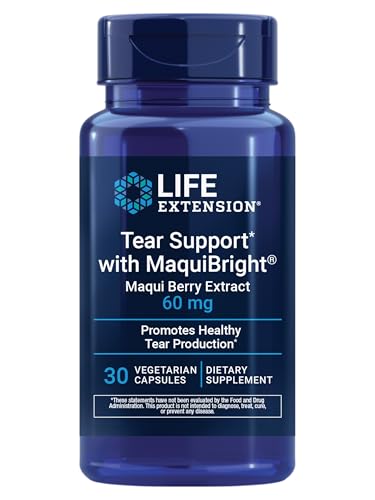
Cost per serving: $$ | 30 servings | 1 capsule per serving
Tear Support is a single small vegetarian capsule of MaquiBright, a standardized maqui berry extract, with no fish oil at all.
Quick Stats
- Active ingredient + form: MaquiBright maqui berry (Aristotelia chilensis) extract, standardized for delphinidins
- Dose per serving: 60 mg
- Dose vs. research: Within studied range (same dose as the placebo-controlled trial)
- Third-party tested: Yes (Life Extension states a Certificate of Analysis is available for every batch)
- Certifications: Non-GMO, gluten-free, vegetarian
- Who should skip: Pregnant or nursing women (the label says to consult a doctor first)
What We Like
The 60 mg dose is the one used in a randomized, placebo-controlled trial of 74 adults with eye dryness and long daily screen time. After four weeks, the maqui berry group produced more tears on the Schirmer test and reported fewer bothersome eye symptoms than the placebo group (Yamashita et al., 2019).
It is one capsule a day with no fishy taste, it is sold and shipped by Amazon, and it is among the cheaper options here.
Watch Out For
The trial was short, funded by the ingredient suppliers, and excluded people already diagnosed with dry eye disease, so it tells us more about screen-related dryness than about moderate or severe dry eye. Tear break-up time did not improve.
What Buyers Report
Buyers often say their eyes feel less dry and that they reach for eye drops less often, and several mention their optometrist suggested it. Some report noticing a difference within the first couple of weeks.
Reviews on effectiveness are split, though: a sizable group says it did nothing noticeable for them. A few mention an unpleasant aftertaste or mild stomach discomfort.
Bottom Line: The easiest fish-free option to try, with a dose that matches its trial, best suited to mild or screen-related dryness.
3. Blink NutriTears – Best Studied Once-Daily Blend
Our rating: 4.5/5
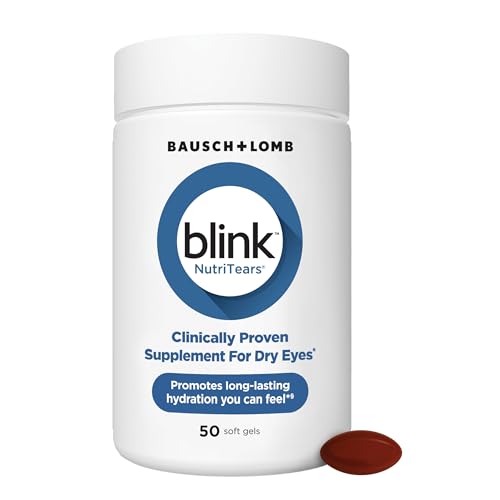
Cost per serving: $$ | 50 servings | 1 softgel per serving
NutriTears from Bausch + Lomb combines lutein, zeaxanthin, curcumin and vitamin D3 in one softgel, with no fish oil.
Quick Stats
- Active ingredient + form: Lutein and zeaxanthin isomers (marigold extract), curcuminoids (turmeric extract), vitamin D3
- Dose per serving: 20 mg lutein, 4 mg zeaxanthin, 200 mg curcuminoids, 600 IU vitamin D3
- Dose vs. research: Within studied range (same formula as the 2024 trial)
- Third-party tested: Not stated
- Certifications: None stated
- Who should skip: Pregnant women and people with liver problems (turmeric)
What We Like
This exact combination was tested in a randomized, placebo-controlled trial of 155 adults with dry eye disease. After eight weeks, the supplement group did better than placebo on tear volume, symptom scores, tear break-up time, tear osmolarity and eye surface staining (Gioia et al., Frontiers in Ophthalmology 2024). That is a larger and more recent trial than most products here can point to.
It is one softgel a day, it is sold and shipped by Amazon, and the bottle lasts 50 days.
Watch Out For
The trial was run with Bausch + Lomb and the ingredient supplier, and it lasted only eight weeks. We could not find an independent certification for this product. The curcumin comes from turmeric extract, and the NCCIH turmeric page notes that liver injury has been reported with some high-absorption curcumin products.
What Buyers Report
Buyers frequently say their eyes feel more moist, their vision feels clearer and they need fewer eye drops during the day.
Complaints focus on value, with some buyers calling it overpriced. A smaller group reports stomach upset, and a few mention the bottle is much larger than the number of softgels inside.
Bottom Line: The best-supported fish-free blend, worth trying if fish oil disagrees with you.
4. EyePromise EZ Tears – Best Omega-3 + Vitamin Blend
Our rating: 4.4/5

Cost per serving: $$$ | 30 servings | 2 softgels per serving
EZ Tears pairs a moderate dose of rTG omega-3s with vitamins A, D and E and a small blend that includes turmeric, green tea extract and evening primrose oil.
Quick Stats
- Active ingredient + form: Omega-3 fish oil (re-esterified triglyceride), vitamin A, vitamin D, vitamin E, proprietary blend
- Dose per serving: 1,100 mg omega-3 (590 mg EPA, 440 mg DHA), 50 mcg (2,000 IU) vitamin D, 300 mcg RAE vitamin A, 40 mg vitamin E, 220 mg blend
- Dose vs. research: Within studied range (close to the 1,000 mg used in one positive trial), below the De3 trial dose
- Third-party tested: Yes (NSF Certified, confirmed in NSF’s public listings, November 2026)
- Certifications: NSF Certified for dietary supplements
- Who should skip: People on blood thinners; pregnant women (turmeric in the blend)
What We Like
EZ Tears is NSF Certified, made by the same company as De3, and sold by the brand. It takes two softgels instead of three, and the omega-3s are in the same rTG form.
Watch Out For
The 220 mg blend does not list how much of each ingredient it contains, so you cannot tell how much turmeric or green tea extract you are getting. The 2,000 IU of vitamin D also counts toward your daily total if you take other vitamin D.
What Buyers Report
Buyers often say their eyes feel more comfortable and moist, and at least one contact lens wearer says they can wear lenses much longer. Many say the softgels are easy to swallow and that they plan to keep taking it.
The main complaints are the price and a fishy smell from the bottle.
Bottom Line: A certified, two-softgel compromise between dose and convenience, held back by its undisclosed blend.
5. Nordic Naturals Ultimate Omega – Best Everyday Fish Oil
Our rating: 4.3/5

Cost per serving: $$$ | 90 servings | 2 softgels per serving
Ultimate Omega is a general-purpose fish oil in triglyceride form, not an eye-specific formula, with 1,100 mg of EPA plus DHA per serving.
Quick Stats
- Active ingredient + form: EPA and DHA as triglycerides, lemon flavored
- Dose per serving: 650 mg EPA, 450 mg DHA (1,280 mg total omega-3s)
- Dose vs. research: Within studied range (above the 1,000 mg used in one positive trial), below the rTG trial dose
- Third-party tested: Not stated (Nordic says it is third-party purity tested but does not name the lab on the listing)
- Certifications: Non-GMO, Friend of the Sea
- Who should skip: People on blood thinners or with a fish allergy
What We Like
It is a well-known, widely used fish oil with a clean ingredient list, a lemon flavor that many people tolerate well, and a 90-day bottle sold by the brand. If you also take fish oil for general health, one product can cover both.
Watch Out For
The dose is about half of what was used in the positive dry eye trial, and we could not find this exact product in NSF’s database (only the Sport versions are listed). Nordic Naturals also recalled one lot of a children’s gummy multivitamin in 2025 because the label left out ingredients, which we count against the brand’s testing score.
What Buyers Report
Buyers widely praise the quality, the lack of fishy burps and the mild lemon taste. Many take it for heart and general health rather than specifically for their eyes.
Value is the most common complaint, and some buyers notice a fishy smell when opening the bottle.
Bottom Line: A good all-round fish oil if you want one product for overall health, not a targeted dry eye dose.
6. Nutricost Fish Oil Omega-3 – Best Value
Our rating: 4.2/5

Cost per serving: $ | 240 servings | 1 softgel per serving
Nutricost offers 560 mg of EPA and DHA in a single 1,000 mg softgel, with about eight months in one bottle.
Quick Stats
- Active ingredient + form: Fish oil (EPA and DHA; form not stated on the listing)
- Dose per serving: 560 mg EPA + DHA combined
- Dose vs. research: Below studied range (take more softgels to approach trial doses)
- Third-party tested: Not stated (the listing mentions only a GMP-compliant, FDA-registered facility)
- Certifications: Non-GMO, gluten-free
- Who should skip: People with a fish allergy; anyone under 18 (per the label)
What We Like
It is by far the cheapest way in this lineup to get EPA and DHA. Because each softgel is inexpensive, you can take more than one to raise the dose and still pay less than most eye-specific formulas.
Watch Out For
The listing does not split EPA and DHA or state the oil form, and it names no independent testing. One softgel gives only about a quarter of the EPA and DHA in De3.
What Buyers Report
Buyers mostly mention the low price, and some say they take it for general health benefits.
The most frequent complaint is taste: some find it has no fishy flavor, while others report a strong fishy taste or burps.
Bottom Line: The budget way to try fish oil for dry eyes, as long as you accept less label detail.
7. HydroEye – Best GLA + Omega Formula
Our rating: 4.1/5

Cost per serving: $$$ | 30 servings | 4 softgels per serving
HydroEye combines GLA from black currant seed oil with smaller amounts of EPA and DHA, plus vitamins A, C, E, B6 and magnesium.
Quick Stats
- Active ingredient + form: Black currant seed oil (source of GLA), fish oil, vitamins and magnesium
- Dose per serving: 1,570 mg black currant seed oil, 100 mg EPA, 70 mg DHA, 625 mcg RAE vitamin A
- Dose vs. research: Within studied range (the brand points to a trial of this GLA plus omega-3 approach)
- Third-party tested: Not stated
- Certifications: None stated
- Who should skip: People on blood thinners (the label warns it may increase their effect)
What We Like
HydroEye takes a different approach from fish oil. Its maker points to a six-month, placebo-controlled trial in 38 postmenopausal women with moderate to severe dry eye, in which a GLA plus omega-3 supplement improved irritation symptoms and kept the corneal surface smoother than placebo (Sheppard et al., Cornea 2013).
It is sold directly by ScienceBased Health on Amazon.
Watch Out For
The trial was small and found no change in tear production or tear break-up time. Four softgels a day is a lot to swallow, the cost per serving is high, and the listing names no independent testing. The vitamin A counts toward your daily total.
What Buyers Report
Buyers frequently say it relieved their dry eye and that they rely less on eye drops, and many mention an eye doctor recommended it. Many also say the softgels are easy to swallow.
The most common complaint is the price.
Bottom Line: Worth a look if fish oil alone has not helped, especially for women after menopause, but costly and untested by a third party.
8. TheraTears Nutrition – Best Fish + Flaxseed Blend
Our rating: 4.0/5
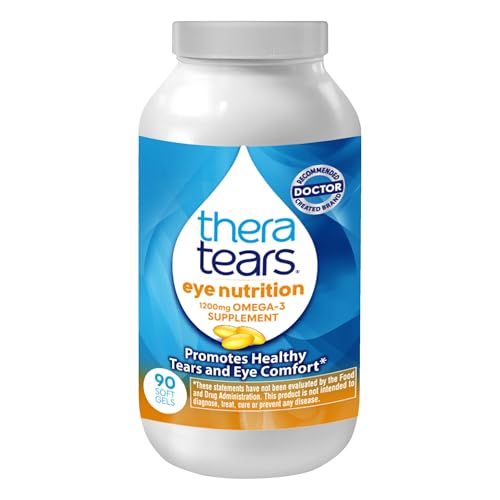
Cost per serving: $$ | 30 servings | 3 softgels per serving
TheraTears Nutrition blends triglyceride fish oil with organic flaxseed oil and vitamin E, from the same brand as the TheraTears eye drops.
Quick Stats
- Active ingredient + form: Fish oil (triglyceride form), flaxseed oil (ALA), vitamin E
- Dose per serving: 450 mg EPA, 300 mg DHA, 450 mg ALA
- Dose vs. research: Below studied range for EPA and DHA
- Third-party tested: Not stated
- Certifications: None stated
- Who should skip: People on blood thinners; people with a soy allergy (soybean oil carrier)
What We Like
It is a reasonably priced, eye-focused omega-3 sold and shipped by Amazon, and it adds plant-based ALA from flaxseed. The brand is familiar to many people who already use its eye drops.
Watch Out For
The EPA and DHA dose is modest, three softgels are needed per serving, and there is no independent testing on the listing. The body converts only a small share of the ALA from flaxseed into EPA and DHA (NIH ODS).
What Buyers Report
Many buyers say it helped their dry eye symptoms, and some say it worked better for them than other treatments they tried.
Swallowing and taste draw the most complaints, with some buyers reporting large softgels and fishy burps.
Bottom Line: A budget-friendly eye omega-3 from a known eye care brand, with a lower dose than the leaders.
Ingredient Breakdown
EPA and DHA (Fish Oil Omega-3s)
EPA and DHA are the long-chain omega-3s in fish oil, and they are the most studied supplements for dry eye. The NIH Office of Dietary Supplements says clinical trials have had mixed results and that there is no consensus on the best dose, form or length of treatment (NIH ODS Omega-3 fact sheet). Positive trials used 1,000 to 2,240 mg a day, while the year-long DREAM trial found 3,000 mg a day no better than an olive oil placebo (NEJM 2018).
Re-Esterified Triglyceride (rTG) Form
Fish oil comes as ethyl esters, natural triglycerides or re-esterified triglycerides. The positive 2016 trial used the rTG form at 1,680 mg EPA and 560 mg DHA (Cornea 2016). No dry eye trial has compared rTG with other forms head to head, so treat it as a reasonable preference rather than a proven advantage.
GLA (Gamma-Linolenic Acid)
GLA is an omega-6 fatty acid found in black currant seed, borage and evening primrose oils. A small six-month trial in postmenopausal women found a GLA plus omega-3 supplement improved irritation symptoms compared with placebo, though tear production did not change (Cornea 2013).
Maqui Berry Extract
Maqui berry is a dark Chilean berry rich in delphinidin-type anthocyanins. In a four-week trial, 60 mg a day of the MaquiBright extract increased tear production in adults with eye dryness and heavy screen use (Yamashita et al., 2019).
Lutein, Zeaxanthin and Curcumin
Lutein and zeaxanthin are carotenoids best known for macular health, and curcumin is the main active compound in turmeric. A combination of 20 mg lutein, 4 mg zeaxanthin, 200 mg curcuminoids and 600 IU vitamin D3 improved tear volume and symptoms in an eight-week trial of 155 adults with dry eye disease (Frontiers in Ophthalmology 2024). For lutein products aimed at age-related eye health, see our guide to the best eye vitamins for seniors. For lutein and zeaxanthin on their own, see our lutein supplements guide.
How to Take Dry Eye Supplements
Take fish oil and other oil-based softgels with a meal that contains some fat, which helps absorption and reduces fishy burps and stomach upset. Astaxanthin also comes in oil-based softgels; see our astaxanthin supplements guide for doses and algae sources. If a serving is three or four softgels, splitting it between two meals is fine; HydroEye’s label suggests two softgels twice a day if four at once upsets your stomach.
Give any dry eye supplement time before you judge it. The trials in this guide ran from four weeks to a year, and several brands suggest 30 to 60 days of daily use. Keep using the eye drops your doctor recommends in the meantime, since the National Eye Institute lists artificial tears, prescription drops and simple changes such as screen breaks and a humidifier as the main treatments.
If you take vitamin D from other sources, add up the totals: De3, EZ Tears and NutriTears all contain vitamin D3. Our vitamin D3 and K2 guide explains how much most adults need.
Safety, Side Effects & Interactions
Omega-3 supplements are generally well tolerated. The most common side effects are mild: an unpleasant taste, bad breath, heartburn, nausea, stomach discomfort, diarrhea and headache (NIH ODS). The FDA has concluded that supplements providing no more than 5 g a day of EPA and DHA are safe when used as recommended, and every product here stays well below that.
- Blood thinners: Fish oil can have antiplatelet effects at high doses and may raise INR in people taking warfarin, so check with your doctor (NIH ODS). HydroEye’s label also warns it may increase the effect of anticoagulants.
- Heart rhythm: Two large trials found that 4 g a day of omega-3s slightly increased the risk of atrial fibrillation in people with or at high risk of heart disease (NIH ODS).
- Turmeric and curcumin (NutriTears, EZ Tears): Liver injury has been reported with some high-absorption curcumin products, and turmeric supplements may be unsafe in pregnancy (NCCIH).
- Vitamin A and D: HydroEye and EZ Tears add vitamin A, and several products add vitamin D, so count them alongside any multivitamin you take.
Who Should Avoid It
- People taking warfarin or other blood thinners, unless their doctor approves
- People with a fish or shellfish allergy (fish oil products)
- Pregnant or breastfeeding women, especially with turmeric-containing formulas
- People with liver disease (curcumin products)
- Anyone with sudden eye pain, vision changes or a red, painful eye, who should see an eye doctor rather than self-treat
How to Choose Supplements for Dry Eyes
Form and Bioavailability
Decide first whether you want fish oil. If you do, look for the EPA and DHA amounts on the label, not just “fish oil” or “total omega-3s”, and note the form (rTG, triglyceride or ethyl ester). If fish oil gives you burps or you avoid fish, maqui berry and lutein-curcumin formulas are the fish-free routes with human trials behind them.
Dosage – What to Look For
Match the dose to a published trial: about 1,680 mg EPA plus 560 mg DHA for the rTG approach, 60 mg MaquiBright for maqui berry, and the full NutriTears formula for the lutein-curcumin approach. A product with half the trial dose may still help, but you are no longer following the evidence.
Third-Party Testing
Only two products here, De3 and EZ Tears, are NSF Certified. When you take several softgels a day for months, a certification or a published Certificate of Analysis is the best outside check that the label matches what is inside.
Cost Per Serving vs. Cost Per Bottle
Bottle prices hide big differences in servings. A large bottle of one-softgel fish oil can cost less per day than a small bottle of an eye-specific formula that needs three or four softgels, so compare cost per serving.
Red Flags on the Label
- “Fish oil 1,000 mg” with no separate EPA and DHA amounts
- Proprietary blends that hide how much of each ingredient you get
- Claims that a supplement cures, treats or replaces medical care for dry eye
- No mention of any testing beyond a “GMP facility”
- Several products stacked together that push vitamin A or D well above your needs
Important: These supplements are not intended to diagnose, treat, cure, or prevent any disease. Results vary by individual. If you have a health condition or take medications, check with your doctor before adding any new supplement to your routine.
FAQ
Do omega-3 supplements really help dry eyes?
The evidence is mixed. Some trials, including one using 1,680 mg EPA and 560 mg DHA in rTG form, found improvements, but the large DREAM trial found 3,000 mg a day no better than placebo, and the NIH Office of Dietary Supplements says there is no consistent relationship so far.
How long do dry eye supplements take to work?
Most people need at least four to eight weeks of daily use before judging a supplement, because the published trials ran from four weeks to a year. If nothing has changed after two to three months, talk to your eye doctor about other options.
What is the best supplement for dry eyes if I don’t want fish oil?
Life Extension Tear Support with MaquiBright and Blink NutriTears are the two fish-free options in this guide, and both use the dose tested in a placebo-controlled trial. NutriTears has the larger trial in people diagnosed with dry eye disease.
Can I take a dry eye supplement with eye drops?
Yes. Supplements are meant as an add-on, and the National Eye Institute lists artificial tears and prescription eye drops as the main treatments for dry eye.
Is rTG fish oil better than regular fish oil for dry eyes?
It may be, but this has not been proven in a head-to-head dry eye trial. The best-known positive trial used rTG fish oil, so choosing rTG simply follows the form that was tested.
Who is most at risk for dry eye?
The National Eye Institute says people aged 50 and older, women, contact lens wearers and people with certain autoimmune conditions are more likely to have dry eye. Low intake of vitamin A or omega-3s is also listed as a risk factor.
Our Take
PRN De3 Omega Benefits is our top pick among supplements for dry eyes because it is NSF Certified and delivers the same EPA and DHA dose, in the same rTG form, as a positive placebo-controlled trial. It is expensive, and the DREAM trial is a reminder that fish oil does not work for everyone.
If you would rather skip fish oil, start with Life Extension Tear Support with MaquiBright for mild or screen-related dryness, or Blink NutriTears for its larger trial in diagnosed dry eye. On a tight budget, Nutricost Fish Oil Omega-3 lets you try fish oil cheaply.
Whichever you choose, take it daily for about two months, keep using your eye drops, and tell your eye doctor what you are taking.
Sources
- n-3 Fatty Acid Supplementation for the Treatment of Dry Eye Disease (DREAM) — New England Journal of Medicine, 2018 (PubMed)
- Effect of Oral Re-esterified Omega-3 Nutritional Supplementation on Dry Eyes — Cornea, 2016 (PubMed)
- Long-term Supplementation With n-6 and n-3 PUFAs Improves Moderate-to-Severe Keratoconjunctivitis Sicca — Cornea, 2013 (PubMed)
- A novel multi-ingredient supplement significantly improves ocular symptom severity and tear production in patients with dry eye disease — Frontiers in Ophthalmology, 2024 (PMC)
- Effects of MaquiBright on improving eye dryness and fatigue in humans — Journal of Traditional and Complementary Medicine, 2019 (PMC)
- Omega-3 Fatty Acids: Health Professional Fact Sheet — NIH Office of Dietary Supplements
- Turmeric: Usefulness and Safety — NCCIH
- Dry Eye — National Eye Institute
Labels, sellers and cost tiers last checked: November 2, 2026.
Update log
- November 9, 2026: Added a link to our new fish oil supplements guide.
- November 2, 2026: First published. 8 products compared.
- November 7, 2026: Added a link to our astaxanthin supplements guide. No product or ranking changes.
- November 11, 2026: Added a link to our algae omega-3 supplements guide. No product or ranking changes.
- November 16, 2026: Added a link to our lutein supplements guide. No ranking changes.


