
| Best Overall | Best Value | Best Softgel | |
|---|---|---|---|
| Pick | Thorne Copper Bisglycinate | Swanson Albion Chelated Copper 2 mg | Micro Ingredients Copper Glycinate Softgels |
| Why | 2 mg of chelated copper per capsule, and the only product here listed in NSF’s dietary supplement database. | 2 mg of Albion copper bisglycinate per tablet for about 3 cents a day. | 2 mg of copper glycinate per small softgel in MCT oil, with 500 softgels per pouch. |
| Cost per day | $$ | $ | $ |
Quick answer: Of the copper supplements we compared, Thorne Copper Bisglycinate ranked first: one capsule gives 2 mg of chelated copper, and it is the only product here listed under NSF/ANSI 173. Swanson Albion Chelated Copper 2 mg gives the same amount for a few cents a day, and Micro Ingredients Copper Glycinate Softgels is the pick if you prefer softgels.
Copper is a trace mineral the body needs for energy production, iron metabolism, connective tissue and the nervous system. Adults need only 900 mcg (0.9 mg) a day, and most people get enough from food, according to the NIH Office of Dietary Supplements.
A supplement makes the most sense for people with a reason to run low, most often those who take high-dose zinc, which blocks copper absorption, or people who have had bariatric bypass surgery. Because too much copper can harm the liver, more is not better: the adult upper limit is 10 mg a day from food and supplements combined.
We compared eight copper supplements on copper per serving, form, testing, other ingredients, cost per day and who sells the listing, plus FDA recalls, using our how we test criteria. Every product here made our shortlist, and our ratings show how they rank against each other. Where two products scored the same or very close, we explain the order in their reviews.
Our Top Picks
Best Overall: Thorne Copper Bisglycinate – CHECK PRICE →
Best Value: Swanson Albion Chelated Copper 2 mg – CHECK PRICE →
Best Softgel: Micro Ingredients Copper Glycinate Softgels – CHECK PRICE →
Simplest Label: NutraBio Copper Bisglycinate 3 mg – CHECK PRICE →
Lowest Dose: Global Healing Bio-Active Copper – CHECK PRICE →
Comparison Table
| Rank | Product | Form | Copper per Serving | Other Ingredients | Cost per Day | Third-Party Tested | Best For |
|---|---|---|---|---|---|---|---|
| 1 | Thorne | Capsule; bisglycinate chelate | 2 mg (1 capsule) | Cellulose, leucine | $$ | NSF/ANSI 173 | Best Overall |
| 2 | Swanson | Tablet; Albion bisglycinate | 2 mg (1 tablet) | Calcium carbonate, cellulose, maltodextrin, binders | $ | Brand claim | Best Value |
| 3 | NutraBio | Capsule; Albion bisglycinate | 3 mg (1 capsule) | Rice flour | $ | Brand claim | Simplest Label |
| 4 | Nutricost | Capsule; bisglycinate | 3 mg (1 capsule) | Rice flour, maltodextrin, magnesium stearate | $ | Brand claim | Low-Cost 3 mg |
| 5 | Bronson | Tablet; Albion bisglycinate | 3 mg (1 tablet) | Cellulose, dicalcium phosphate, binders | $ | Brand claim | Large Bottle, 3 mg |
| 6 | Formula IQ | Capsule; Albion bisglycinate | 2 mg (1 capsule) | Vegetable capsule | $$ | Not stated | Small Capsule |
| 7 | Micro Ingredients | Softgel; glycinate in MCT oil | 4 mg (2 softgels) | MCT oil, gelatin softgel | $ | Not stated | Best Softgel |
| 8 | Global Healing | Capsule; cuprous nicotinate | 0.9 mg (1 capsule) | Organic gum acacia | $$$ | Not stated | Lowest Dose |
Cost tiers per day at the label serving: $ under $0.20 · $$ $0.20–$0.50 · $$$ over $0.50 (checked November 2026). Only Thorne Copper Bisglycinate was listed in NSF’s dietary supplement database when we checked, and none of these brands had an FDA recall in the past three years.
In-Depth Reviews: Top 8 Copper Supplements of 2026
1. Thorne Copper Bisglycinate – Best Overall
Our rating: 4.8/5
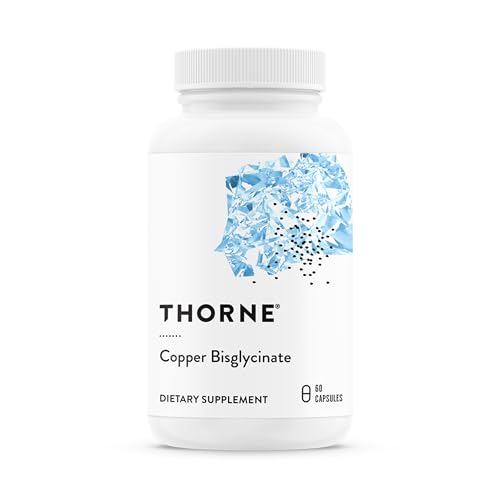
Cost: $$ (per day) | 60 servings | 1 capsule per serving
2 mg of chelated copper in an NSF-listed capsule.
Quick Stats
- Active ingredient + form: Copper as TRAACS copper bisglycinate chelate
- Dose per serving: 2 mg (1 capsule); the label allows 1 to 3 capsules a day
- Dose vs. research: About twice the 0.9 mg RDA and well under the 10 mg upper limit at one capsule
- Third-party tested: Yes; Thorne Copper Bisglycinate is listed under NSF/ANSI 173
- Certifications: NSF/ANSI 173
- Who should skip: Anyone with Wilson disease or liver disease, and anyone who already gets copper from a multivitamin unless their doctor approves
What We Like
Independent certification is rare for copper, and this is the only product here with it. The capsule is small, the other ingredients are cellulose, the capsule and leucine, and Pattern, Thorne’s authorized Amazon reseller, sells the listing. Buyers often take it to balance zinc.
Watch Out For
At about 32 cents a capsule, it costs ten times as much as Swanson for the same 2 mg. The label allows up to three capsules (6 mg), more than most people need. Some buyers report nausea.
What Buyers Report
Buyers frequently mention trust in the brand, small capsules and raising low copper levels while taking zinc.
Nausea and the price are the main complaints.
Bottom Line: The best-tested copper here; one capsule a day is enough for most people.
2. Swanson Albion Chelated Copper 2 mg – Best Value
Our rating: 4.7/5

Cost: $ (per day) | 300 servings | 1 tablet per serving
2 mg of Albion copper bisglycinate for a few cents a day.
Quick Stats
- Active ingredient + form: Copper from Albion copper bisglycinate chelate
- Dose per serving: 2 mg (1 tablet)
- Dose vs. research: About twice the 0.9 mg RDA and well under the 10 mg upper limit
- Third-party tested: The brand says it tests its products but does not name a lab
- Certifications: None listed
- Who should skip: Anyone with Wilson disease or liver disease, and anyone who already gets copper from a multivitamin unless their doctor approves
What We Like
A 300-tablet bottle costs about 3 cents a day, the lowest here, and the slim tablet is easy to swallow. It has one of the largest buyer bases in this category, and Pattern, Swanson’s authorized reseller, sells the listing.
NutraBio scored 1 point higher, and the scores were close; we placed Swanson ahead because its 2 mg dose is closer to what most people need and it costs a fraction as much per day.
Watch Out For
The tablet adds calcium carbonate, cellulose, maltodextrin and several binders. Some buyers report nausea.
What Buyers Report
Buyers frequently mention good value, quality and an easy-to-swallow tablet.
Nausea is the main complaint.
Bottom Line: The cheapest way to take a well-known chelated copper.
3. NutraBio Copper Bisglycinate 3 mg – Simplest Label
Our rating: 4.6/5

Cost: $ (per day) | 90 servings | 1 capsule per serving
Albion copper with rice flour as the only filler.
Quick Stats
- Active ingredient + form: Copper as 32 mg Albion copper bisglycinate chelate
- Dose per serving: 3 mg (1 capsule)
- Dose vs. research: More than three times the 0.9 mg RDA and well under the 10 mg upper limit
- Third-party tested: The brand describes its testing but the listing does not name an outside lab
- Certifications: None listed
- Who should skip: Anyone with Wilson disease or liver disease, and anyone who already gets copper from a multivitamin unless their doctor approves
What We Like
The label states both the copper and the amount of chelate, and the only other ingredient is rice flour in a vegetable capsule. The brand sells the listing, and it costs about 17 cents a day.
Watch Out For
At 3 mg, it gives more than most people need; some buyers take it every other day. A few report nausea.
What Buyers Report
Buyers frequently mention good quality, value and an easy-to-swallow capsule.
Some feel 3 mg is too high a daily dose.
Bottom Line: The cleanest label here, at a slightly higher dose.
4. Nutricost Copper Glycinate 3 mg – Low-Cost 3 mg
Our rating: 4.5/5
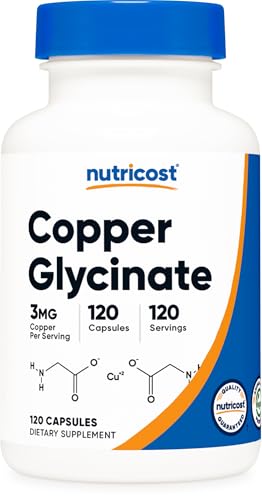
Cost: $ (per day) | 120 servings | 1 capsule per serving
3 mg of copper bisglycinate at a low daily cost.
Quick Stats
- Active ingredient + form: Copper as copper bisglycinate
- Dose per serving: 3 mg (1 capsule)
- Dose vs. research: More than three times the 0.9 mg RDA and well under the 10 mg upper limit
- Third-party tested: The listing says third-party tested but does not name a lab
- Certifications: Made in an NSF-certified, GMP-compliant facility (listing)
- Who should skip: Anyone with Wilson disease or liver disease, and anyone who already gets copper from a multivitamin unless their doctor approves
What We Like
A 120-capsule bottle costs about 8 cents a day, buyers often describe it as gentle on the stomach, and the listing is sold by eSupplements, which owns the Nutricost brand.
Watch Out For
The capsule adds rice flour, maltodextrin and magnesium stearate, and 3 mg is more than most people need. A buyer complained the bottle seal is hard to remove.
What Buyers Report
Buyers frequently mention good quality, value and an easy, gentle capsule.
The bottle seal draws the only repeated complaint.
Bottom Line: A low-cost 3 mg capsule from a well-known budget brand.
5. Bronson Copper 3 mg – Large Bottle, 3 mg
Our rating: 4.4/5

Cost: $ (per day) | 180 servings | 1 tablet per serving
Albion copper in a six-month bottle.
Quick Stats
- Active ingredient + form: Copper as Albion copper bisglycinate chelate
- Dose per serving: 3 mg (1 tablet), preferably with a meal
- Dose vs. research: More than three times the 0.9 mg RDA and well under the 10 mg upper limit
- Third-party tested: The brand says its products are laboratory tested but does not name a lab
- Certifications: None listed
- Who should skip: Anyone with Wilson disease or liver disease, and anyone who already gets copper from a multivitamin unless their doctor approves
What We Like
A 180-tablet bottle costs about 6 cents a day, the tablets are small, and buyers rarely mention stomach upset. The brand sells the listing.
Watch Out For
The tablet adds cellulose, dicalcium phosphate, stearic acid, magnesium stearate, silica and polyethylene glycol. Some buyers say it breaks down in the mouth and tastes bad if not swallowed quickly.
What Buyers Report
Buyers frequently mention quality, value and no side effects.
Taste and a crumbly tablet are the main complaints.
Bottom Line: A large, low-cost bottle of 3 mg Albion copper.
6. Formula IQ Copper IQ – Small Capsule
Our rating: 4.3/5

Cost: $$ (per day) | 60 servings | 1 capsule per serving
2 mg of Albion copper in a very small capsule.
Quick Stats
- Active ingredient + form: Copper as Albion copper bisglycinate
- Dose per serving: 2 mg (1 capsule)
- Dose vs. research: About twice the 0.9 mg RDA and well under the 10 mg upper limit
- Third-party tested: Not stated
- Certifications: None listed
- Who should skip: Anyone with Wilson disease or liver disease, and anyone who already gets copper from a multivitamin unless their doctor approves
What We Like
The capsule is tiny, the dose is 2 mg, and the label is short. Some buyers say it does not make them nauseous. The brand sells the listing.
Watch Out For
At about 24 cents a day, it costs much more than Swanson for the same 2 mg, no testing is stated, and the buyer base is small.
What Buyers Report
Buyers frequently mention tiny capsules and no nausea.
Slow delivery and a small number of reviews are the main drawbacks.
Bottom Line: An easy-to-swallow 2 mg capsule at a moderate price.
7. Micro Ingredients Copper Glycinate Softgels – Best Softgel
Our rating: 4.2/5

Cost: $ (per day) | 250 servings | 2 softgels per serving
Small copper glycinate softgels in MCT oil.
Quick Stats
- Active ingredient + form: Copper as copper glycinate, in MCT oil
- Dose per serving: 4 mg (2 softgels); 2 mg per softgel
- Dose vs. research: The label serving is more than four times the 0.9 mg RDA; one softgel (2 mg) is closer to what most people need
- Third-party tested: Not stated
- Certifications: Made in a cGMP-compliant facility (listing)
- Who should skip: Vegetarians (gelatin softgel); anyone with a coconut allergy (MCT oil); anyone with Wilson disease or liver disease
What We Like
It is the only softgel here, the softgels are small, and a 500-count pouch lasts eight months at the label serving or more than a year at one softgel. The brand’s parent company sells the listing.
Watch Out For
The label serving of two softgels gives 4 mg, more than most people need. The softgel contains gelatin and added color, no testing is stated, and one buyer noted there was no certificate of analysis.
What Buyers Report
Buyers frequently mention small softgels, quality and value.
Some think the label dose is higher than needed.
Bottom Line: A low-cost softgel; one a day is enough for most people.
8. Global Healing Bio-Active Copper – Lowest Dose
Our rating: 4.1/5

Cost: $$$ (per day) | 30 servings | 1 capsule per serving
0.9 mg of copper, the daily requirement, in one capsule.
Quick Stats
- Active ingredient + form: Copper as cuprous nicotinic acid
- Dose per serving: 0.9 mg (1 capsule)
- Dose vs. research: Equal to the 0.9 mg RDA
- Third-party tested: Not stated
- Certifications: None listed
- Who should skip: Anyone with Wilson disease or liver disease, and anyone who already gets copper from a multivitamin unless their doctor approves
What We Like
It is the only product here that gives exactly the daily requirement, which suits people who get some copper from food and want a small top-up. The only other ingredients are organic gum acacia and the capsule, and the brand sells the listing.
Best Naturals scored the same; we placed Global Healing ahead because its 0.9 mg dose matches the RDA, while the Best Naturals label serving is 6 mg.
Watch Out For
At about $1.67 a day, it costs far more than every other product here. The copper form is uncommon, and no testing is stated. Some buyers felt nauseous when taking it on an empty stomach.
What Buyers Report
Buyers frequently mention quality and little nausea when taken with food.
Price is the main complaint.
Bottom Line: The lowest dose here, at a very high price.
Products We Left Out
- High-dose products: We left out tablets whose label serving gives 6 to 8 mg a day, close to the 10 mg upper limit once food is counted.
- Liquid trace mineral drops: One popular liquid adds magnesium and a trace mineral concentrate to copper sulfate, so it is not a single-ingredient copper supplement.
- Products with very few reviews: Several newer listings had too few buyer reviews to judge, many of them free-product reviews.
- Combination formulas: Copper with zinc, multivitamins and mineral blends are outside this single-ingredient guide.
- Listings sold by unconfirmed third-party sellers: We left out listings when we could not confirm the seller was the brand, Amazon or an authorized reseller.
- Several large brands: Left out under our brand rules.
Ingredient Breakdown
What Copper Does
Copper is part of enzymes involved in energy production, iron metabolism, connective tissue, brain chemistry and the immune system, according to the NIH Office of Dietary Supplements.
How Much You Need
The adult RDA is 900 mcg (0.9 mg) a day, 1 mg in pregnancy and 1.3 mg while breastfeeding. The upper limit for adults is 10 mg a day from food and supplements combined (ODS). Supplements on the market range from a few micrograms to 15 mg.
Forms of Copper
Supplements use cupric oxide, cupric sulfate, copper gluconate or amino acid chelates such as copper bisglycinate. ODS notes that no studies have compared how well these forms are absorbed, so “chelated” on a label is a reasonable choice but not a proven advantage.
Who May Run Low
- High-dose zinc users: Excess zinc blocks copper absorption and can cause copper deficiency (ODS). Zinc-containing denture creams can contribute.
- After bariatric surgery: A 2019 review found that severe copper deficiency after bypass surgery has become frequent.
- Celiac disease and Menkes disease: Both reduce copper absorption (ODS).
Signs of Deficiency
The 2019 review describes anemia and nerve damage in the spinal cord and limbs (myeloneuropathy) as the main problems, along with effects on the heart, skin and immune system. Because the signs are nonspecific, low copper needs a blood test and a doctor’s assessment, not self-treatment.
How to Take Copper
- Amount: For most people, 1 to 2 mg a day from a supplement is plenty on top of food. Doses above that are for people whose doctor has found low copper.
- With zinc: If you take zinc long term, ask your doctor whether you need copper, and see our zinc supplements guide for zinc doses.
- With food: Several buyers report nausea when taking copper on an empty stomach; a meal usually helps.
- Count your multivitamin: Many multivitamins already contain copper, so add up all sources.
- Related guides: For iron, which depends on copper for normal use, see our gentle iron supplements guide.
Safety, Side Effects & Interactions
- Too much copper: Long-term high intake can damage the liver and cause nausea, vomiting and diarrhea (ODS).
- Wilson disease: People with this inherited condition build up copper and should not take copper supplements.
- Zinc: Zinc reduces copper absorption; high-dose zinc is a known cause of copper deficiency.
- Medicines: ODS states that copper is not known to have clinically relevant interactions with medications.
- Stomach upset: Nausea is the most common complaint among buyers of several products here.
Who Should Avoid It
- Anyone with Wilson disease
- Anyone with liver disease, unless their doctor approves
- Anyone already getting copper from a multivitamin, unless their doctor approves
- Children, unless a doctor recommends it
How to Choose a Copper Supplement
Dose
Look for 1 to 2 mg per serving unless your doctor has found low copper. Check whether the label serving is more than one tablet.
Form
Chelated forms such as copper bisglycinate are common and well tolerated, though no studies have compared absorption between forms.
Testing
Only one product here was listed in NSF’s database. A named lab or certificate of analysis is the next best sign.
Other Ingredients
The simplest labels add only rice flour or cellulose. Softgels contain gelatin.
Cost per Day
Products here cost from about 3 cents to $1.67 a day at the label serving.
Red Flags on the Label
- More than 5 mg of copper per daily serving without a doctor’s advice
- Copper sulfate or copper oxide in a product marketed as “high absorption”
- Mineral blends that hide how much copper you get
- Claims to treat anemia, gray hair or arthritis
- Unknown third-party sellers
Important: These supplements are not intended to diagnose, treat, cure, or prevent any disease. Results vary by individual. If you have a health condition or take medications, check with your doctor before adding any new supplement to your routine.
FAQ
What is the best copper supplement?
In our comparison, Thorne Copper Bisglycinate ranked first for its 2 mg chelated dose and NSF/ANSI 173 listing. Swanson costs the least per day, and Micro Ingredients is the only softgel.
What is the best form of copper to take?
Copper bisglycinate and other amino acid chelates are popular and well tolerated, but no studies have compared absorption between forms.
How much copper should I take a day?
Adults need 0.9 mg a day, mostly from food. A 1 to 2 mg supplement is enough for most people, and total intake should stay under 10 mg a day.
Should I take copper with zinc?
High-dose zinc can cause copper deficiency. If you take zinc long term, ask your doctor whether you also need copper.
What are signs of low copper?
Anemia and nerve problems such as numbness or trouble walking are the main signs, but they have many causes. A blood test is needed to confirm low copper.
Can you take too much copper?
Yes. Long-term high intake can damage the liver, and people with Wilson disease should not take copper supplements.
Our Take
Thorne Copper Bisglycinate is our top pick among copper supplements for its 2 mg chelated dose and NSF/ANSI 173 listing. Swanson Albion Chelated Copper 2 mg gives the same amount for a few cents a day, and NutraBio Copper Bisglycinate 3 mg has the simplest label.
Choose Nutricost for a low-cost 3 mg capsule, Bronson for a large bottle, Formula IQ for a tiny capsule, Micro Ingredients for a softgel, or Global Healing if you want only the daily requirement.
Practical tip: take 1 to 2 mg with a meal, count the copper in your multivitamin, and ask your doctor before taking copper if you have liver disease.
Sources
- Copper — Fact Sheet for Health Professionals, NIH Office of Dietary Supplements
- Copper Deficiency: Causes, Manifestations, and Treatment (2019) — PubMed
Labels, sellers and cost tiers last checked: November 23, 2026.
Update log
- November 23, 2026: First published. 8 products compared.


