
| Best Overall | Best Value | Best One-Drop Dose | |
|---|---|---|---|
| Pick | MaryRuth’s Organic Vitamin A Liquid Drops | Nutricost Vitamin A 10,000 IU | Seeking Health Vitamin A Drops |
| Why | 750 mcg per serving, close to the daily need, in organic MCT oil with Clean Label Project certification. | A 500-softgel bottle for about 3 cents a day, at the 3,000 mcg upper limit. | 750 mcg in a single drop, with 600 servings in a bottle. |
| Cost per serving | $ | $ | $ |
Quick answer: Of the vitamin A supplements we compared, MaryRuth’s Organic Vitamin A Liquid Drops ranked first: a serving gives 750 mcg, close to what most adults need in a day, it is certified organic, and it carries Clean Label Project certification. Nutricost Vitamin A 10,000 IU costs the least per day but gives the full 3,000 mcg upper limit in each softgel, and Seeking Health Vitamin A Drops gives 750 mcg in one drop.
Vitamin A supports vision, the immune system and cell growth. Adult men need 900 mcg RAE (retinol activity equivalents) a day and women 700 mcg, according to the NIH Office of Dietary Supplements, and most people in the U.S. get enough from food such as liver, eggs, dairy and orange and green vegetables.
Too much is the bigger risk. The upper limit for preformed vitamin A (retinol and its esters, the form in these supplements) is 3,000 mcg a day for adults. Most “10,000 IU” softgels give exactly that amount, so food adds on top of it. High intakes are linked to birth defects in pregnancy, liver problems and, in one large study, a higher risk of hip fracture.
We compared eight vitamin A supplements on dose, testing, other ingredients, cost per day and who sells the listing, plus recent FDA recalls, using our how we test criteria. Because of the upper limit, we gave the most credit for dose to products close to the daily need and did not rank any product above 3,000 mcg. Every product here made our shortlist, and our ratings show how they rank against each other. Where two products scored the same, we explain the order in their reviews.
Our Top Picks
Best Overall: MaryRuth’s Organic Vitamin A Liquid Drops – CHECK PRICE →
Best Value: Nutricost Vitamin A 10,000 IU – CHECK PRICE →
Best One-Drop Dose: Seeking Health Vitamin A Drops – CHECK PRICE →
Best Tested Drops: Peak Performance Organic Vitamin A Liquid Drops – CHECK PRICE →
Best Chewable: EZ Melts Vitamin A 5,000 IU – CHECK PRICE →
Comparison Table
| Rank | Product | Form | Per Serving | Vitamin A per Serving | % of Upper Limit | Cost per Day | Third-Party Tested | Best For |
|---|---|---|---|---|---|---|---|---|
| 1 | MaryRuth’s | Liquid drops (retinyl palmitate) | 10 drops | 750 mcg | 25% | $ | Clean Label Project | Best Overall |
| 2 | Peak Performance | Liquid drops (retinyl palmitate) | 9 drops | 750 mcg | 25% | $ | Test report on listing | Tested Drops |
| 3 | Seeking Health | Liquid drops (retinyl palmitate) | 1 drop | 750 mcg | 25% | $ | Brand claim | One-Drop Dose |
| 4 | Nutricost | Softgel (retinyl palmitate) | 1 softgel | 3,000 mcg | 100% | $ | Brand claim | Value |
| 5 | Bronson | Softgel (retinyl palmitate) | 1 softgel | 3,000 mcg | 100% | $ | Not stated | Most Popular |
| 6 | Nature’s Way | Softgel (fish liver oil, retinyl palmitate) | 1 softgel | 3,000 mcg | 100% | $ | Not stated | Clear Pregnancy Warning |
| 7 | 365 by Whole Foods Market | Softgel (fish liver oil, retinyl palmitate) | 1 softgel | 3,000 mcg | 100% | $ | Not stated | Store Brand |
| 8 | EZ Melts | Dissolving tablet (retinyl acetate) | 1 tablet | 1,500 mcg | 50% | $ | Brand claim | Chewable |
Cost tiers per day at the label serving: $ under $0.35 · $$ $0.35–$0.65 · $$$ over $0.65 (checked November 2026). The upper limit is 3,000 mcg a day of preformed vitamin A for adults, including during pregnancy. None of these products was listed in NSF’s dietary supplement database when we checked.
In-Depth Reviews: Top 8 Vitamin A Supplements of 2026
1. MaryRuth’s Organic Vitamin A Liquid Drops – Best Overall
Our rating: 4.8/5

Cost per serving: $ | 90 servings | 10 drops per serving
A daily-need dose in organic drops, with outside contaminant testing.
Quick Stats
- Active ingredient + form: Vitamin A (as retinyl palmitate), 750 mcg
- Dose per serving: 750 mcg (10 drops, 0.3 mL)
- Dose vs. research: Close to the 700 to 900 mcg adults need; 25% of the upper limit
- Third-party tested: The listing shows Clean Label Project certification, which tests for contaminants and checks label accuracy
- Certifications: USDA Organic, Clean Label Project Certified, vegan (listing)
- Who should skip: Anyone pregnant or who could become pregnant unless their doctor approves, people with liver disease, people taking retinoid medicines, and people allergic to coconut
What We Like
A 750 mcg serving covers most of an adult’s daily need without approaching the upper limit, and the dropper makes it easy to take less. The only other ingredients are organic MCT oil and vitamin E, and the brand sells the listing.
Watch Out For
The MCT oil comes from coconut. Taste draws mixed comments, with some buyers calling it oily or rancid. The label is for ages 14 and up.
What Buyers Report
Buyers frequently mention good quality, easy dosing and an organic, filler-free formula.
Taste draws mixed comments.
Bottom Line: The best balance of a sensible dose, clean ingredients and outside testing.
2. Peak Performance Organic Vitamin A Liquid Drops – Best Tested Drops
Our rating: 4.7/5

Cost per serving: $ | about 100 servings | 9 drops per serving
Oil-free drops with a test report on the listing.
Quick Stats
- Active ingredient + form: Vitamin A (as retinyl palmitate), 750 mcg RAE
- Dose per serving: 750 mcg (9 drops, 0.3 mL)
- Dose vs. research: Close to the 700 to 900 mcg adults need; 25% of the upper limit
- Third-party tested: The listing shows a certificate of analysis with microbial and heavy metal results but does not name the lab
- Certifications: USDA Organic, vegan (listing)
- Who should skip: Anyone pregnant or who could become pregnant unless their doctor approves, people with liver disease, and people taking retinoid medicines
What We Like
The only other ingredients are organic glycerin and water, and the drops mix easily into water or juice. The listing shows passing results for microbes and heavy metals, and the brand sells the listing.
Watch Out For
Glycerin gives it a sweet taste that some buyers like and others find medicinal. It has a smaller buyer base than most products here. The label includes directions for children 4 and up; ask a pediatrician before giving vitamin A to a child.
What Buyers Report
Buyers frequently mention easy mixing into drinks, a sweet taste and a good dropper.
A few dislike the taste.
Bottom Line: A simple, oil-free 750 mcg drop with test results you can see.
3. Seeking Health Vitamin A Drops – Best One-Drop Dose
Our rating: 4.6/5

Cost per serving: $ | 600 servings | 1 drop per serving
750 mcg in a single drop, from a bottle that lasts well over a year.
Quick Stats
- Active ingredient + form: Vitamin A (as retinyl palmitate), 750 mcg RAE
- Dose per serving: 750 mcg (1 drop)
- Dose vs. research: Close to the 700 to 900 mcg adults need; 25% of the upper limit
- Third-party tested: The brand says its products are third-party tested for microbes and heavy metals; no certificate for this product is shown
- Certifications: Not stated
- Who should skip: Anyone pregnant or who could become pregnant unless their doctor approves, people with liver disease, and people taking retinoid medicines
What We Like
One drop is the whole serving, and 600 servings make it one of the cheapest options per day. The listing is sold by Pattern, the brand’s authorized reseller.
Watch Out For
The other ingredients are a long list, including glycerin, sunflower lecithin, MCT oil, acacia, choline bitartrate, potassium sorbate and an antioxidant blend with CoQ10 and astaxanthin. Many buyers find the taste bitter, and some report a thick or lumpy texture or changes between batches.
What Buyers Report
Buyers frequently mention good quality, a one-drop dose and good value.
Taste and texture draw complaints.
Bottom Line: The easiest way to measure a daily-need dose, with a longer ingredient list.
4. Nutricost Vitamin A 10,000 IU – Best Value
Our rating: 4.5/5
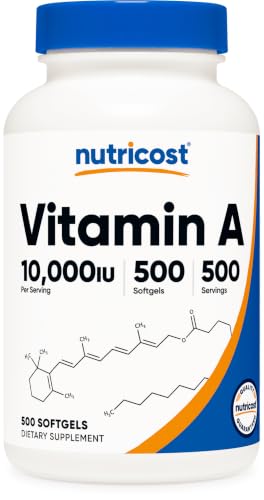
Cost per serving: $ | 500 servings | 1 softgel per serving
The lowest daily cost here, at the full upper-limit dose.
Quick Stats
- Active ingredient + form: Vitamin A (from retinyl palmitate), 3,000 mcg RAE (10,000 IU)
- Dose per serving: 3,000 mcg (1 softgel)
- Dose vs. research: Equal to the 3,000 mcg upper limit, so vitamin A from food adds on top
- Third-party tested: The listing shows a “third party tested” badge but does not name a lab
- Certifications: Non-GMO, gluten-free, made in a GMP-compliant facility (listing)
- Who should skip: Anyone pregnant or who could become pregnant, people with liver disease or osteoporosis, and people taking retinoid medicines, unless their doctor approves
What We Like
A 500-softgel bottle lasts well over a year at about 3 cents a day, and buyers say the softgels are small. The other ingredients are sunflower oil, gelatin, glycerin and water. The listing is sold by eSupplements, which owns the Nutricost trademark.
Watch Out For
Each softgel gives the full upper limit, so daily use is best only when a doctor recommends it, for example for a diagnosed deficiency. Some buyers find the dose too high.
What Buyers Report
Buyers frequently mention good value, small softgels and a bottle that lasts a long time.
A few say the dose is too high for daily use.
Bottom Line: The cheapest high-dose softgel, best used under a doctor’s guidance.
5. Bronson Vitamin A 10,000 IU – Most Popular
Our rating: 4.4/5

Cost per serving: $ | 250 servings | 1 softgel per serving
By far the most-reviewed vitamin A on Amazon in our lineup.
Quick Stats
- Active ingredient + form: Vitamin A (as retinyl palmitate), 3,000 mcg RAE (10,000 IU)
- Dose per serving: 3,000 mcg (1 softgel)
- Dose vs. research: Equal to the 3,000 mcg upper limit, so vitamin A from food adds on top
- Third-party tested: Not stated on the listing
- Certifications: Non-GMO, made in a cGMP facility (listing)
- Who should skip: Anyone pregnant or who could become pregnant, people with liver disease or osteoporosis, and people taking retinoid medicines, unless their doctor approves
What We Like
It has by far the largest buyer base here, the softgels are small, and it costs about 4 cents a day. The brand sells the listing. Nature’s Way scored the same; Bronson ranks higher because far more buyers have reviewed it.
Watch Out For
Each softgel gives the full upper limit, and no testing is stated. The other ingredients are soybean oil, gelatin, glycerin and water. Some buyers report nausea or headaches.
What Buyers Report
Buyers frequently mention good quality, good value and small, easy-to-swallow softgels.
A minority report nausea or headaches.
Bottom Line: A popular, low-cost high-dose softgel without stated testing.
6. Nature’s Way Vitamin A 3,000 mcg – Clearest Pregnancy Warning
Our rating: 4.3/5

Cost per serving: $ | 100 servings | 1 softgel per serving
A high-dose softgel with a clear birth-defect warning on the label.
Quick Stats
- Active ingredient + form: Vitamin A (from fish liver oil and retinyl palmitate), 3,000 mcg
- Dose per serving: 3,000 mcg (1 softgel)
- Dose vs. research: Equal to the 3,000 mcg upper limit, so vitamin A from food adds on top
- Third-party tested: Not stated on the listing
- Certifications: Gluten-free, dairy-free (label)
- Who should skip: Anyone pregnant or trying to become pregnant (as the label says), people with fish or soy allergies, people with liver disease or osteoporosis, and people taking retinoid medicines
What We Like
The label warns plainly against use in pregnancy and notes that high amounts of vitamin A from retinol are known to cause birth defects. It costs about 6 cents a day, and Amazon sells the listing.
Watch Out For
It contains soy and fish (cod, saithe, haddock and pollock), and no testing is stated. Each softgel gives the full upper limit.
What Buyers Report
Buyers frequently mention good quality, good value and small softgels.
A few report side effects.
Bottom Line: A trusted brand with the clearest safety warning among the high-dose softgels.
7. 365 by Whole Foods Market Vitamin A 10,000 IU – Best Store Brand
Our rating: 4.2/5
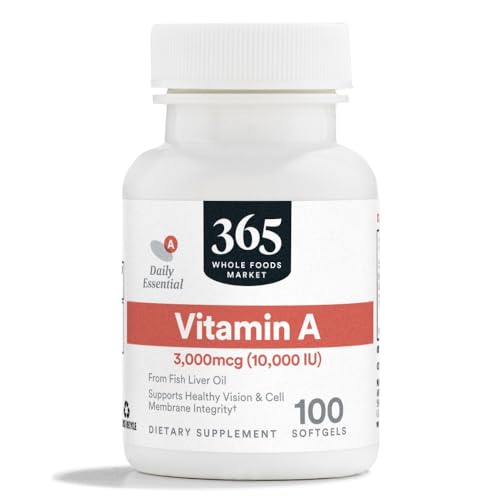
Cost per serving: $ | 100 servings | 1 softgel per serving
A low-cost store-brand softgel sold by Amazon.
Quick Stats
- Active ingredient + form: Vitamin A (from fish liver oil and retinyl palmitate), 3,000 mcg
- Dose per serving: 3,000 mcg (1 softgel)
- Dose vs. research: Equal to the 3,000 mcg upper limit, so vitamin A from food adds on top
- Third-party tested: Not stated on the listing
- Certifications: Not stated
- Who should skip: Anyone pregnant or who could become pregnant, people with fish or soy allergies, people with liver disease or osteoporosis, and people taking retinoid medicines, unless their doctor approves
What We Like
It costs about 7 cents a day, Amazon sells the listing, and buyers often describe the softgels as small. The label says to take it with food, which helps absorption.
Watch Out For
The other ingredients are soybean oil, gelatin, glycerin and water, and the fish liver oil makes it unsuitable for people with fish allergies. No testing is stated, and each softgel gives the full upper limit. Some buyers report nausea.
What Buyers Report
Buyers frequently mention good quality, good value and small softgels.
A few report nausea or say the dose is too high.
Bottom Line: A cheap, simple store-brand softgel at the full upper-limit dose.
8. EZ Melts Vitamin A 5,000 IU – Best Chewable
Our rating: 4.1/5

Cost per serving: $ | 60 servings | 1 tablet per serving
A dissolving tablet for people who can’t swallow pills.
Quick Stats
- Active ingredient + form: Vitamin A (as retinyl acetate), 1,500 mcg (5,000 IU)
- Dose per serving: 1,500 mcg (1 tablet, dissolved in the mouth)
- Dose vs. research: About twice what most adults need; 50% of the upper limit
- Third-party tested: The brand says its products are third-party tested; no certificate for this product is shown
- Certifications: Vegan, non-GMO (listing)
- Who should skip: Anyone pregnant or who could become pregnant unless their doctor approves, people with liver disease, people taking retinoid medicines, and people sensitive to sugar alcohols
What We Like
The tablet dissolves on the tongue with no water, and buyers often like the taste. The dose sits between the drops and the softgels here, and the brand’s company sells the listing.
Watch Out For
It is sweetened with mannitol, xylitol and monk fruit; xylitol is toxic to dogs, so store it out of a pet’s reach. A 60-tablet bottle makes it the priciest product here per day, and a few buyers report headaches.
What Buyers Report
Buyers frequently mention a good taste, fast dissolving and ease for people who can’t swallow pills.
A few report headaches, and value draws mixed comments.
Bottom Line: The easiest vitamin A to take without water, at a moderate dose.
Products We Left Out
- Why Not Natural Vitamin A Drops: Its company (Art Monkey LLC) had a voluntary FDA recall of another product in January 2026, which takes it below our cutoff. A full dropper also gives the full 3,000 mcg upper limit.
- Klaire Labs Micellized Vitamin A: The Amazon listing was sold by a third-party seller we could not confirm as an authorized reseller when we checked.
- 15,000 and 25,000 IU softgels: These give 4,500 to 7,500 mcg of preformed vitamin A, well above the 3,000 mcg adult upper limit, so we did not rank any of them.
- High-dose beta-carotene (25,000 IU): These give about 15 mg of beta-carotene a day. In two large trials in smokers, 20 to 30 mg a day raised lung cancer risk (see Safety below).
- Multi-ingredient products: Vitamin A combined with vitamin D, K or other carotenoids is outside this single-ingredient guide.
- Kids’ products and gummies: Children’s dosing belongs with a pediatrician, and most gummies add sugar.
- Several large brands: Left out under our brand rules.
Ingredient Breakdown
Retinyl Palmitate
Retinyl palmitate is the most common form of preformed vitamin A in supplements and is used in seven of the eight products here. It is stored mainly in the liver, which is why intakes above the upper limit can build up over time.
Retinyl Acetate
Retinyl acetate is another preformed form, used in EZ Melts. The NIH Office of Dietary Supplements lists both retinyl acetate and retinyl palmitate as the usual preformed forms in supplements.
Fish Liver Oil
Nature’s Way and 365 get part of their vitamin A from fish liver oil. That matters for people with fish allergies, and for anyone also taking cod liver oil, which adds more preformed vitamin A.
Beta-Carotene
Beta-carotene is a provitamin A carotenoid that the body converts to vitamin A as needed. The ODS notes that beta-carotene has no upper limit and does not cause the birth defects linked to high preformed vitamin A, but high-dose supplements raised lung cancer risk in smokers, so we did not rank any high-dose beta-carotene products.
IU vs. mcg RAE
Labels now list vitamin A in micrograms of retinol activity equivalents (mcg RAE). For preformed vitamin A, 1 IU equals 0.3 mcg RAE, so 10,000 IU is 3,000 mcg and 2,500 IU is 750 mcg.
What the Research Shows
- Daily need: The ODS sets the RDA at 900 mcg RAE for men and 700 mcg for women, 770 mcg in pregnancy and 1,300 mcg while breastfeeding. The upper limit for preformed vitamin A is 3,000 mcg a day for adults, including during pregnancy and breastfeeding.
- Who may need more: The ODS lists premature infants, people in low-income countries and people with cystic fibrosis or conditions that affect fat absorption, such as Crohn’s disease, ulcerative colitis and celiac disease, as groups at risk of low vitamin A. Most people in the U.S. get enough from food.
- Pregnancy: In a 1995 study of 22,748 pregnant women, those who took more than 10,000 IU a day of preformed vitamin A from supplements had about 4.8 times the rate of birth defects linked to the cranial neural crest (affecting the face, brain and heart) compared with women taking 5,000 IU or less, with risk concentrated in supplements taken before the seventh week of pregnancy.
- Bone health: In a 2002 study that followed 72,337 postmenopausal women for 18 years, women with total vitamin A intakes of 3,000 mcg a day or more had a 48% higher risk of hip fracture than those with less than 1,250 mcg. The link was with retinol, not beta-carotene.
How to Take Vitamin A Supplements
- Take it with a meal that contains fat: Vitamin A is fat-soluble, and the 365 label says to take it with food.
- Count your other sources: Multivitamins, cod liver oil, beef liver supplements and liver itself all add preformed vitamin A. See our multivitamins for seniors guide, cod liver oil supplements guide and beef liver supplements guide before stacking them.
- Choose the lowest dose that does the job: A 750 mcg drop covers most adults’ daily need. Use a 3,000 mcg softgel daily only when a doctor recommends it.
- Measure drops carefully: Serving sizes range from 1 drop to 10 drops, so read the label of the product you have.
- Related guides: For eye health, see our lutein supplements guide and eye vitamins for seniors guide.
Safety, Side Effects & Interactions
- Too much vitamin A: The ODS says high intakes of preformed vitamin A can cause headache, blurred vision, nausea and dizziness, and over time dry skin, joint pain, fatigue, depression and abnormal liver tests.
- Pregnancy: Preformed vitamin A above the upper limit can cause birth defects. The ODS says pregnant and breastfeeding people should not take more than 3,000 mcg RAE (10,000 IU) a day from supplements.
- Bone health: High retinol intake has been linked to a higher risk of hip fracture in older women, so people with osteoporosis should ask a doctor before taking high-dose vitamin A.
- Smokers and beta-carotene: In the CARET trial, 30 mg of beta-carotene plus 25,000 IU of retinyl palmitate a day raised lung cancer risk by 28% and lung cancer deaths by 46% in smokers and asbestos-exposed workers, and in the ATBC trial 20 mg of beta-carotene raised lung cancer risk by 18% in male smokers, according to the ODS.
- Medicines: The ODS says orlistat can lower vitamin A absorption, and retinoid medicines such as acitretin, bexarotene and isotretinoin raise the risk of too much vitamin A when combined with supplements.
Who Should Avoid It
- Anyone pregnant or who could become pregnant, unless their doctor approves
- People with liver disease
- People with osteoporosis, unless their doctor approves
- People taking retinoid medicines
- Smokers and former smokers (high-dose beta-carotene products)
- Children, unless a doctor recommends it
How to Choose a Vitamin A Supplement
Dose
Check the micrograms of RAE on the Supplement Facts. For daily use without a doctor’s advice, a product near 700 to 900 mcg leaves room for vitamin A from food. Avoid anything above 3,000 mcg of preformed vitamin A.
Form
Drops make it easy to take a smaller amount. Softgels are cheap but usually give the full 3,000 mcg. Dissolving tablets help people who can’t swallow pills.
Testing
No vitamin A product here was listed in NSF’s database. Clean Label Project certification, as on MaryRuth’s, or a test report on the listing, as on Peak Performance, is the strongest check we found.
Cost per Day
Every product here costs under 35 cents a day at the label serving, from about 3 cents for Nutricost to about 32 cents for EZ Melts.
Red Flags on the Label
- Preformed vitamin A above 3,000 mcg (10,000 IU) per serving
- High-dose beta-carotene for smokers
- Claims to cure acne, eye disease or other conditions
- Listings sold by unknown third-party sellers
Important: These supplements are not intended to diagnose, treat, cure, or prevent any disease. Results vary by individual. If you have a health condition or take medications, check with your doctor before adding any new supplement to your routine.
FAQ
What is the best vitamin A supplement?
In our comparison, MaryRuth’s Organic Vitamin A Liquid Drops ranked first for its 750 mcg daily-need dose, clean ingredients and Clean Label Project certification. Nutricost is the best value, and Seeking Health gives 750 mcg in one drop.
How much vitamin A should I take a day?
Adult men need 900 mcg RAE a day and women 700 mcg, according to the NIH Office of Dietary Supplements. Most people get enough from food, and the upper limit for preformed vitamin A is 3,000 mcg a day.
Is 10,000 IU of vitamin A too much?
10,000 IU of preformed vitamin A equals 3,000 mcg, the adult upper limit. Taking it daily on top of food can push total intake above that limit, so use it only if your doctor recommends it.
Is vitamin A safe during pregnancy?
Pregnant people need a little more vitamin A, but preformed vitamin A above the upper limit can cause birth defects. Check how much vitamin A your prenatal vitamin already gives, and ask your doctor before adding a separate supplement.
What is the difference between retinol and beta-carotene?
Retinol and its esters are preformed vitamin A, which the body uses directly. Beta-carotene is converted to vitamin A as needed, has no upper limit and does not cause birth defects, but high doses raised lung cancer risk in smokers.
What are the signs of too much vitamin A?
The ODS lists headache, blurred vision, nausea and dizziness for very high intakes, and dry skin, joint pain, fatigue and liver problems for high intakes over time.
Our Take
MaryRuth’s Organic Vitamin A Liquid Drops is our top pick among vitamin A supplements for its daily-need dose, organic ingredients and Clean Label Project certification. Peak Performance is the best-tested oil-free drop, Seeking Health gives the same dose in one drop, and Nutricost is the best value when your doctor recommends a higher dose.
Choose Bronson, Nature’s Way or 365 by Whole Foods Market for a low-cost high-dose softgel, or EZ Melts if you can’t swallow pills.
Practical tip: add up the vitamin A in your multivitamin and any cod liver oil before adding a separate supplement, and stay at or below 3,000 mcg of preformed vitamin A a day.
Sources
- Vitamin A and Carotenoids: Fact Sheet for Health Professionals — NIH Office of Dietary Supplements
- Teratogenicity of high vitamin A intake (1995) — PubMed
- Vitamin A intake and hip fractures among postmenopausal women (2002) — PubMed
Labels, sellers and cost tiers last checked: November 21, 2026.
Update log
- November 21, 2026: First published. 8 products compared.


