
| Best Overall | Best Organic | Best Value | |
|---|---|---|---|
| Pick | HMS Nutrition Korean Red Panax Ginseng | Zazzee Organic Red Korean Panax Ginseng | Nutricost Panax Ginseng 1,000 mg |
| Why | 2,000 mg of Korean red ginseng with 5% ginsenosides, and the only product here listed in NSF’s certified supplement database. | 1,000 mg of USDA Organic red ginseng root extract with 5% ginsenosides, in a pullulan capsule with rice hulls. | 1,000 mg of Panax ginseng extract per serving and a four-month bottle at about 14 cents a day. |
| Cost per serving | $$ | $$ | $ |
Quick answer: Of the Panax ginseng supplements we compared, HMS Nutrition Korean Red Panax Ginseng ranked first: three capsules give 2,000 mg of Korean red ginseng standardized to 5% ginsenosides, and it is the only product here we found listed in NSF’s certified dietary supplement database. If you want a certified organic option, Zazzee Organic Red Korean Panax Ginseng is the pick, and Nutricost Panax Ginseng 1,000 mg costs the least per day.
Panax ginseng, also called Asian or Korean ginseng, is the root of Panax ginseng, a slow-growing plant native to Korea and northeast China. Its main active compounds are ginsenosides. Korean red ginseng is the same root, steamed and dried, which changes its color and some of its ginsenosides. American ginseng (Panax quinquefolius) and Siberian ginseng (eleuthero) are different plants and are not covered here.
The research is mixed. Reviews suggest modest help with fatigue and a small effect on erectile function, while a Cochrane review found no convincing evidence that ginseng improves thinking in healthy people. Insomnia is the most common side effect, and ginseng can interact with blood thinners and diabetes medicines.
We compared eight Panax ginseng supplements on ginseng and ginsenosides per serving, plant part, testing, other ingredients, cost per day and who sells the listing, plus recent FDA recalls, using our how we test criteria. Every product here made our shortlist, and our ratings show how they rank against each other. Where two products scored the same or very close, we explain the order in their reviews.
Our Top Picks
Best Overall: HMS Nutrition Korean Red Panax Ginseng – CHECK PRICE →
Best Organic: Zazzee Organic Red Korean Panax Ginseng – CHECK PRICE →
Best Value: Nutricost Panax Ginseng 1,000 mg – CHECK PRICE →
Best Korean Red Ginseng Sticks: Jung Kwan Jang Everytime – CHECK PRICE →
Best High-Ginsenoside: NatureBell Korean Red Ginseng 2,250 mg – CHECK PRICE →
Best Whole-Root Powder: Herbtonics Korean Red Panax Ginseng – CHECK PRICE →
Comparison Table
| Rank | Product | Form | Per Serving | Ginseng per Serving | Ginsenosides per Serving | Cost per Day | Third-Party Tested | Best For |
|---|---|---|---|---|---|---|---|---|
| 1 | HMS Nutrition | Vegan capsule | 3 capsules | 2,000 mg red ginseng extract | About 100 mg (5%) | $$ | Yes (NSF) | Best Overall |
| 2 | NutraChamps | Vegan capsule | 2 capsules | 1,200 mg red ginseng root extract | About 60 mg (min. 5%) | $ | Brand certificate (lab not named) | Runner-Up |
| 3 | Zazzee | Vegan capsule | 2 capsules | 1,000 mg organic red ginseng root extract | About 50 mg (5%) | $$ | Brand claim | Organic |
| 4 | Jung Kwan Jang Everytime | Liquid stick | 1 stick (10 mL) | 3,000 mg red ginseng root extract | Not stated | $$$ | Not stated | Korean Red Ginseng Sticks |
| 5 | Nutricost | Capsule | 2 capsules | 1,000 mg root extract | About 10 mg (1%) | $ | Brand claim | Value |
| 6 | NatureBell | Softgel (gelatin) | 3 softgels | 2,250 mg root extract | About 225 mg (10%) | $ | Brand claim | High-Ginsenoside |
| 7 | Herbtonics | Vegan capsule | 2 capsules | 1,500 mg red ginseng root powder | Not stated | $ | Not stated | Whole-Root Powder |
| 8 | Double Wood | Capsule | 2 capsules | 1,000 mg leaf and stem extract | About 100 mg (10%) | $ | Brand claim | Leaf-and-Stem Extract |
Cost tiers per day at the label serving: $ under $0.35 · $$ $0.35–$0.65 · $$$ over $0.65 (checked November 2026). Ginsenoside amounts are calculated from the percentage on each label.
In-Depth Reviews: Top 8 Panax Ginseng Supplements of 2026
1. HMS Nutrition Korean Red Panax Ginseng – Best Overall
Our rating: 4.8/5

Cost per serving: $$ | 40 servings | 3 capsules per serving
The only ginseng here with an NSF listing we could confirm.
Quick Stats
- Active ingredient + form: Korean red Panax ginseng extract, standardized to 5% ginsenosides
- Dose per serving: 2,000 mg, about 100 mg ginsenosides (3 capsules)
- Dose vs. research: Matches the upper 2 g a day of extract used in a fatigue trial
- Third-party tested: Yes. HMS Nutrition’s Korean Panax Ginseng appears in NSF’s certified dietary supplement database (checked November 2026)
- Certifications: NSF/ANSI 173 certified, vegan capsules (listing)
- Who should skip: Anyone pregnant or breastfeeding, children, and people taking blood thinners, diabetes medicines or MAO inhibitors, unless their doctor approves
What We Like
NSF certification means an outside organization checks that the label matches what is in the bottle and screens for contaminants, and this is the only product in our lineup where we could confirm a listing. The serving gives 2,000 mg with a stated 5% ginsenosides, the listing says it contains no fillers or binders, and the brand sells it.
Watch Out For
The listing does not show a Supplement Facts panel, so the dose and ginsenoside percentage come from the product title and description. A serving is three capsules, so a 120-capsule bottle lasts 40 days. Some buyers report headaches, and a few noticed the price going up.
What Buyers Report
Buyers frequently mention steady energy without jitters, good value and reordering several times.
Effectiveness draws mixed comments, and a few report headaches.
Bottom Line: The ginseng to choose if verified testing matters most to you.
2. NutraChamps Korean Red Panax Ginseng – Best Runner-Up
Our rating: 4.7/5

Cost per serving: $ | 60 servings | 2 capsules per serving
A standardized red ginseng extract with a published certificate of analysis.
Quick Stats
- Active ingredient + form: Korean red Panax ginseng 10:1 root extract, standardized to at least 5% ginsenosides
- Dose per serving: 1,200 mg, about 60 mg ginsenosides (2 capsules)
- Dose vs. research: Within the 1 to 2 g a day of extract used in a fatigue trial
- Third-party tested: The listing shows a certificate of analysis with passing heavy-metal and microbial results and 5.15% ginsenosides, from an ISO lab it does not name
- Certifications: Vegan, non-GMO, gluten-free, made in a cGMP facility (label)
- Who should skip: Anyone pregnant or breastfeeding, children, and people taking blood thinners, diabetes medicines or MAO inhibitors, unless their doctor approves
What We Like
The label states the plant part, the extract ratio and a minimum ginsenoside percentage, and the certificate of analysis shows a measured result above that minimum. The other ingredients are only rice flour and the capsule. It has by far the largest buyer base here and costs about 29 cents a day.
Watch Out For
The certificate does not name the lab. The front of the bottle mentions a 20:1 extract, while the Supplement Facts panel says 10:1. A few buyers felt jittery or nervous, and some say the effects faded over time.
What Buyers Report
Buyers frequently mention more energy and stamina, better focus and good value.
Some report jitters or side effects, and a few found the benefits wore off.
Bottom Line: A well-labeled, low-cost red ginseng with a lab report and the biggest buyer base here.
3. Zazzee Organic Red Korean Panax Ginseng – Best Organic
Our rating: 4.6/5
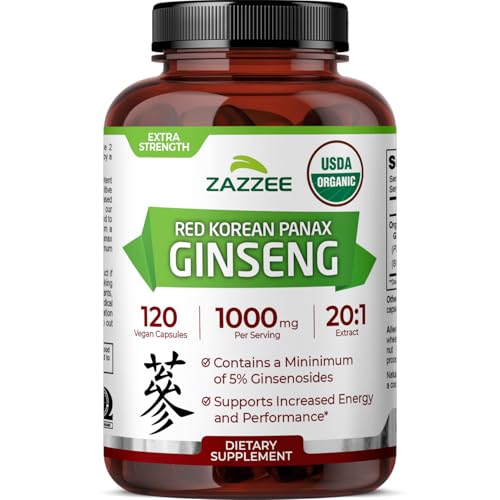
Cost per serving: $$ | 60 servings | 2 capsules per serving
The only USDA Organic ginseng in our lineup.
Quick Stats
- Active ingredient + form: Organic red Korean Panax ginseng 20:1 root extract, standardized to at least 5% ginsenosides
- Dose per serving: 1,000 mg, about 50 mg ginsenosides (2 capsules)
- Dose vs. research: At the low end of the 1 to 2 g a day of extract used in a fatigue trial
- Third-party tested: The label shows a “lab tested” badge but does not name a lab
- Certifications: USDA Organic, vegan, non-GMO, made in the USA (label)
- Who should skip: Anyone pregnant or breastfeeding, children, and people taking blood thinners, diabetes medicines or MAO inhibitors, unless their doctor approves
What We Like
It is certified organic, uses the root, and states the extract ratio and ginsenoside percentage. The other ingredients are only organic rice hulls and a pullulan capsule, and the brand sells the listing.
Watch Out For
At about 42 cents a day, it costs more than most capsules here, and organic certification is not a purity or potency test. One buyer received broken capsules, another reported acid reflux, and one asked whether the ginseng comes from Korea or China.
What Buyers Report
Buyers frequently mention good quality, potency and steady energy.
Effectiveness and value draw mixed comments.
Bottom Line: The clean organic choice, at a moderate premium.
4. Jung Kwan Jang Everytime – Best Korean Red Ginseng Sticks
Our rating: 4.5/5
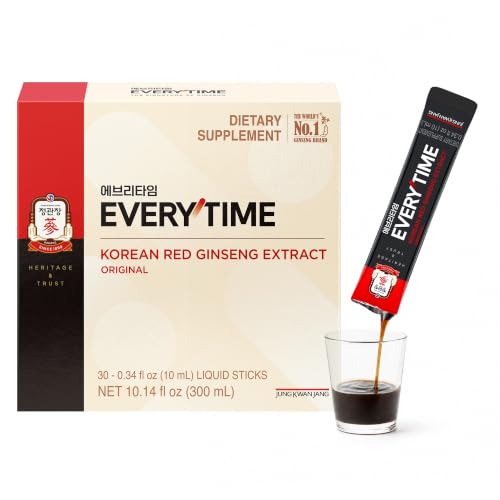
Cost per serving: $$$ | 30 servings | 1 stick per serving
Korean red ginseng extract in ready-to-take liquid sticks.
Quick Stats
- Active ingredient + form: G1899 Korean red ginseng root extract with purified water
- Dose per serving: 3,000 mg (one 10 mL stick)
- Dose vs. research: Close to the 2,700 mg a day of Korean red ginseng used in an erectile-function trial
- Third-party tested: Not stated on the listing
- Certifications: Vegan, gluten-free, caffeine-free, non-GMO, GMP quality (label)
- Who should skip: Anyone pregnant or breastfeeding, children, and people taking blood thinners, diabetes medicines or MAO inhibitors, unless their doctor approves
What We Like
Jung Kwan Jang, also known as CheongKwanJang, is a long-established Korean red ginseng brand, and the stick holds only red ginseng extract and water. The serving is the largest here and close to the daily amount in the erectile-function trial we cite. The single-serve sticks are easy to carry, and the brand sells the listing.
Watch Out For
At about $3 a stick, it costs far more than any capsule here, and the label does not state ginsenoside content. Many buyers find it bitter. Herbtonics scored the same; Jung Kwan Jang ranks higher because it gives more ginseng per serving.
What Buyers Report
Buyers frequently mention more energy, the convenience of the sticks and trusting the brand.
The bitter taste and the price are the main complaints.
Bottom Line: The traditional Korean red ginseng experience, at a premium price.
5. Nutricost Panax Ginseng 1,000 mg – Best Value
Our rating: 4.4/5

Cost per serving: $ | 120 servings | 2 capsules per serving
A four-month bottle at the lowest daily cost here.
Quick Stats
- Active ingredient + form: Panax ginseng root extract, standardized to 1% ginsenosides
- Dose per serving: 1,000 mg, about 10 mg ginsenosides (2 capsules)
- Dose vs. research: At the low end of the 1 to 2 g a day of extract used in a fatigue trial
- Third-party tested: The listing says “3rd party tested” but does not name a lab
- Certifications: Gluten-free, non-GMO, soy-free; made in an NSF-registered, GMP-compliant facility (listing)
- Who should skip: Anyone pregnant or breastfeeding, children, and people taking blood thinners, diabetes medicines or MAO inhibitors, unless their doctor approves
What We Like
At about 14 cents a day, it costs the least here, and one bottle lasts four months. The label states the plant part and a ginsenoside percentage. The listing is sold by eSupplements, which owns the Nutricost trademark. Herbtonics scored one point higher; Nutricost ranks here because the scores were close and it costs about half as much per day.
Watch Out For
At 1%, it has the lowest stated ginsenoside percentage here, and the capsule contains dextrin. A facility registered with NSF is not the same as an NSF-certified product. One buyer reported higher blood pressure, and the taste and smell draw mixed comments.
What Buyers Report
Buyers frequently mention steady energy without jitters, good value and easy-to-swallow capsules.
Some feel no change, and one reported a rise in blood pressure.
Bottom Line: The cheapest way to try Panax ginseng daily, with a lighter ginsenoside content.
6. NatureBell Korean Red Ginseng 2,250 mg – Best High-Ginsenoside
Our rating: 4.3/5

Cost per serving: $ | 80 servings | 3 softgels per serving
The most ginsenosides per serving in our lineup.
Quick Stats
- Active ingredient + form: Panax ginseng root extract, standardized to 10% ginsenosides, in softgels
- Dose per serving: 2,250 mg, about 225 mg ginsenosides (3 softgels)
- Dose vs. research: Above the 1 to 2 g a day of extract used in a fatigue trial; many buyers take fewer softgels
- Third-party tested: The listing says “third-party tested” but does not name a lab
- Certifications: Non-GMO, gluten-free, soy-free (label)
- Who should skip: Vegetarians and vegans, anyone pregnant or breastfeeding, children, and people taking blood thinners, diabetes medicines or MAO inhibitors, unless their doctor approves
What We Like
The label states the plant part and a 10% ginsenoside percentage, and a bottle lasts 80 days at about 27 cents a day. You can take one or two softgels instead of three if the full serving feels too strong. The listing is sold by Pattern, NatureBell’s authorized Amazon reseller. Herbtonics scored two points higher; NatureBell ranks here because the scores were close and it states its ginsenoside content, which Herbtonics does not.
Watch Out For
The listing calls them vegetarian softgels, but the Supplement Facts panel lists gelatin. The full serving is well above the amounts used in the studies we cite, and more is not known to work better. Some buyers find the softgels too big, report headaches, or question whether the ginseng is authentic.
What Buyers Report
Buyers frequently mention a noticeable energy boost and good value for a large bottle.
Pill size, headaches and authenticity draw mixed comments.
Bottom Line: A potent, low-cost softgel if you start with a smaller serving and eat gelatin.
7. Herbtonics Korean Red Panax Ginseng – Best Whole-Root Powder
Our rating: 4.2/5
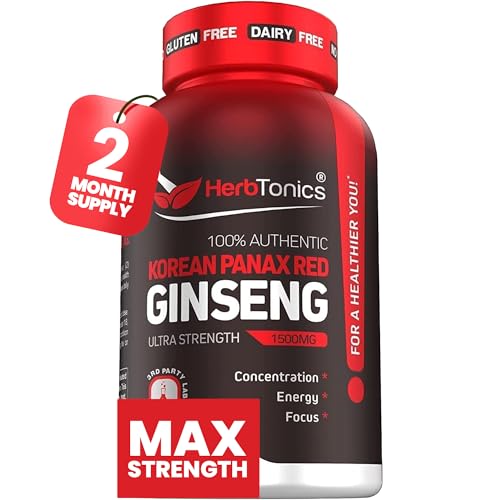
Cost per serving: $ | 60 servings | 2 capsules per serving
Plain Korean red ginseng root powder with nothing added.
Quick Stats
- Active ingredient + form: Korean red ginseng root powder (not an extract)
- Dose per serving: 1,500 mg (2 capsules)
- Dose vs. research: About half the 2,700 mg a day of Korean red ginseng used in an erectile-function trial
- Third-party tested: Not stated on the listing
- Certifications: Vegan, non-GMO, made in the USA (label)
- Who should skip: Anyone pregnant or breastfeeding, children, and people taking blood thinners, diabetes medicines or MAO inhibitors, unless their doctor approves
What We Like
The only ingredients are the red ginseng root and the capsule, which is as simple as a label gets. It has one of the largest buyer bases here, and buyers often mention jitter-free energy and focus. It costs about 31 cents a day.
Watch Out For
The label does not state ginsenoside content, and no testing is listed. A few buyers received bottles with broken seals, and one said the label and the capsules changed between orders.
What Buyers Report
Buyers frequently mention steady energy, better focus and mood, and easy-to-swallow capsules.
A few report damaged seals or a change in the product.
Bottom Line: The simplest red ginseng label here, without published testing.
8. Double Wood Korean Red Panax Ginseng – Best Leaf-and-Stem Extract
Our rating: 4.1/5

Cost per serving: $ | 120 servings | 2 capsules per serving
A 10% ginsenoside extract made from the leaf and stem.
Quick Stats
- Active ingredient + form: Panax ginseng leaf and stem extract, standardized to 10% ginsenosides
- Dose per serving: 1,000 mg, about 100 mg ginsenosides (2 capsules)
- Dose vs. research: The studies we cite used root preparations, not leaf and stem
- Third-party tested: The label shows a “third-party tested” badge but does not name a lab
- Certifications: Made in a GMP-certified facility in the USA, non-GMO, gluten-free (label)
- Who should skip: Anyone pregnant or breastfeeding, children, and people taking blood thinners, diabetes medicines or MAO inhibitors, unless their doctor approves
What We Like
It states a high ginsenoside percentage, a bottle lasts four months, and it costs about 21 cents a day. The brand sells the listing, and buyers often mention better mood and energy.
Watch Out For
The label says leaf and stem, not root, even though the product name says Korean red ginseng. Leaf and stem extracts have a different mix of ginsenosides than the root and are far less studied in people. The other ingredients include microcrystalline cellulose and silicon dioxide, and some buyers report headaches.
What Buyers Report
Buyers frequently mention more energy, a better mood and good value.
Side effects draw mixed comments, mostly headaches.
Bottom Line: A low-cost, high-ginsenoside option, but not the root used in the studies we cite.
Products We Left Out
- Nature’s Way Asian Ginseng: A familiar brand sold by Amazon, but the label does not state ginsenoside content and it costs about 47 cents a day. It scored just below Double Wood.
- NutraHarmony Panax Ginseng 1,500 mg: A low-cost 10:1 extract, but the label does not state the plant part or ginsenoside content.
- Auragin Korean Red Ginseng: Made in Korea from six-year roots, but the listing shows no Supplement Facts panel, the stated 8% ginsenosides is high for whole root, and it costs about $1 for 900 mg.
- Nootropics Depot GS15-4: A fermented extract with very few buyer reviews so far.
- Prince of Peace and Pharmaton: The listings we found were sold by unknown third-party sellers.
- Ginseng with ginkgo, maca or other herbs, and American or Siberian ginseng: Outside this single-ingredient Panax ginseng guide.
- NOW, Solgar and Carlyle: Left out under our brand rules.
Ingredient Breakdown
What Panax Ginseng Contains
The main active compounds in Panax ginseng are ginsenosides, a family of saponins. Labels that state a ginsenoside percentage let you work out how much you take; “10:1” or “20:1” extract ratios and “equivalent to” claims do not.
Red vs. White Ginseng, Root vs. Leaf
White ginseng is dried root; red ginseng is root that has been steamed and then dried, which changes some of its ginsenosides. Most products here are red ginseng root. Double Wood uses leaf and stem, which has a different ginsenoside mix and less human research.
What the Research Shows
- Fatigue: A 2018 systematic review of 10 studies found modest evidence that Asian and American ginseng help fatigue in people with chronic illness, with a low risk of side effects. In a 4-week trial in 90 adults with unexplained chronic fatigue, 1 or 2 g a day of Panax ginseng extract improved mental fatigue scores, but not total fatigue scores, compared with placebo.
- Erectile function: A 2021 Cochrane review of nine trials in 587 men found that ginseng may have only a trivial effect on erectile function scores, though more men reported being able to have intercourse. In one 8-week crossover trial in 45 men, Korean red ginseng at 900 mg three times a day improved erectile function scores compared with placebo.
- Thinking and memory: A Cochrane review found no convincing evidence that Panax ginseng improves thinking in healthy people, and no high-quality evidence in dementia.
- Blood sugar: A 2014 meta-analysis of 16 trials found that ginseng modestly lowered fasting blood glucose, with no significant effect on HbA1c or insulin. The NCCIH calls the research on blood sugar control in diabetes inconclusive and conflicting.
- Overall: The MSD Manual does not recommend ginseng, citing no proven health benefit along with the risk of side effects and drug interactions.
How to Take Panax Ginseng
- Follow the label: The trials we cite used 1 to 2 g a day of extract, or 2.7 g a day of Korean red ginseng.
- Take it in the morning: Insomnia is the most common side effect, so avoid taking it late in the day.
- Start low with high-potency products: Several buyers of the stronger products here take fewer capsules than the label serving.
- Use it for limited periods: The NCCIH says short-term use of up to 6 months appears safe for most people, and the MSD Manual notes that some authorities advise limiting use to 3 months.
- Related guides: For other herbs people take for energy and stress, see our rhodiola supplements guide and ashwagandha supplements guide. Ginseng is often sold with ginkgo; for ginkgo on its own, see our ginkgo biloba supplements guide. Maca is another root often taken for energy; see our maca root supplements guide.
Safety, Side Effects & Interactions
- Side effects: The NCCIH lists insomnia as the most common side effect. The MSD Manual also lists nervousness, headaches, low blood sugar, digestive problems, breast tenderness and menstrual changes, and rarely higher blood pressure and abnormal heart rhythms.
- Blood clotting: The NCCIH says ginseng may interfere with blood clotting, and the MSD Manual lists medicines that prevent blood clots, aspirin and other NSAIDs among its interactions.
- Blood sugar: The NCCIH says ginseng might lower blood sugar, so people taking diabetes medicines should check with their doctor first.
- Other medicines: The MSD Manual lists MAO inhibitors, corticosteroids, digoxin, estrogen therapy and some heart-rhythm drugs as possible interactions.
- Autoimmune conditions: The NCCIH notes ginseng may worsen autoimmune disorders.
Who Should Avoid It
- Anyone pregnant or breastfeeding, and children
- People taking blood thinners, aspirin or NSAIDs regularly, unless their doctor approves
- People with diabetes or taking diabetes medicines, unless their doctor approves
- People taking MAO inhibitors or heart-rhythm medicines, or with an autoimmune disorder, unless their doctor approves
How to Choose a Panax Ginseng Supplement
Testing
NSF certification is the strongest check we found; HMS Nutrition was the only product here with a confirmed listing. A certificate of analysis that names the lab is the next best thing.
Ginsenoside Percentage and Plant Part
Look for “root” and a stated ginsenoside percentage on the Supplement Facts panel. Products here range from 1% to 10%, which changes how much you actually take.
Form
Capsules are easiest to dose. Liquid sticks are convenient but cost much more. Softgels may contain gelatin.
Cost per Day
Products here range from about 14 cents to $3 a day at the label serving.
Red Flags on the Label
- No plant part listed, or leaf and stem sold as “root” ginseng
- Only an extract ratio or an “equivalent to” milligram claim, with no ginsenoside percentage
- “Ginseng” blends that hide how much Panax ginseng you get
- “Vegetarian” claims that do not match the Supplement Facts panel
- Claims to treat erectile dysfunction, diabetes or other conditions
Important: These supplements are not intended to diagnose, treat, cure, or prevent any disease. Results vary by individual. If you have a health condition or take medications, check with your doctor before adding any new supplement to your routine.
FAQ
What is the best Panax ginseng supplement?
In our comparison, HMS Nutrition Korean Red Panax Ginseng ranked first for its stated ginsenosides and confirmed NSF certification. Zazzee is the best organic option, and Nutricost costs the least per day.
Is Korean red ginseng the same as Panax ginseng?
Yes. Korean red ginseng is Panax ginseng root that has been steamed and dried. American ginseng and Siberian ginseng are different plants.
How much Panax ginseng should I take a day?
The trials we cite used 1 to 2 g a day of extract or 2.7 g a day of Korean red ginseng. Follow the label and ask your doctor first.
Does Panax ginseng help with energy?
Reviews suggest a modest benefit for fatigue, especially in people with chronic illness, but results are not consistent.
Can ginseng keep you awake?
Yes. Insomnia is the most common side effect, so take it in the morning.
Is Panax ginseng safe to take every day?
Short-term use of up to 6 months appears safe for most people, according to the NCCIH. It can interact with blood thinners and diabetes medicines, and people who are pregnant or breastfeeding should avoid it.
Our Take
HMS Nutrition Korean Red Panax Ginseng is our top pick among Panax ginseng supplements for its 2,000 mg serving, stated ginsenosides and confirmed NSF certification. NutraChamps is a close runner-up with a published lab report, Zazzee is the best organic option, and Nutricost is the best value.
Choose Jung Kwan Jang Everytime for traditional Korean red ginseng sticks, NatureBell for the most ginsenosides per serving, Herbtonics for plain root powder, or Double Wood for a low-cost leaf and stem extract.
Practical tip: check that the label says “root” and gives a ginsenoside percentage, and take ginseng in the morning.
Sources
- Ginseng for erectile dysfunction (2021) — Cochrane Database of Systematic Reviews, PubMed
- A double-blind crossover study evaluating the efficacy of Korean red ginseng in patients with erectile dysfunction (2002) — PubMed
- Ginseng as a Treatment for Fatigue: A Systematic Review (2018) — PubMed
- Antifatigue effects of Panax ginseng C.A. Meyer: a randomised, double-blind, placebo-controlled trial (2013) — PubMed
- Ginseng for cognition (2010) — Cochrane Database of Systematic Reviews, PubMed
- The effect of ginseng (the genus Panax) on glycemic control: a systematic review and meta-analysis (2014) — PubMed
- Asian Ginseng — National Center for Complementary and Integrative Health
- Ginseng — MSD Manual Consumer Version
Labels, sellers and cost tiers last checked: November 20, 2026.
Update log
- November 20, 2026: First published. 8 products compared.
- November 20, 2026: Added a link to our ginkgo biloba supplements guide. No product or ranking changes.
- November 23, 2026: Added a link to our maca root supplements guide. No product or ranking changes.


