
| Best Overall | Best Value | Best Synbiotic | |
|---|---|---|---|
| Pick | Thorne Bacillus Coagulans | Jarrow Saccharomyces Boulardii + MOS | Seed DS-01 Daily Synbiotic |
| Why | A shelf-stable spore strain (MTCC 5856) tested in a placebo-controlled IBS trial, and NSF certified. | A probiotic yeast for about a quarter a day, from a 180-capsule bottle. | 24 named strains plus a prebiotic, tested as a finished product in a 350-person bloating trial. |
| Cost per serving | $$ | $ | $$$ |
Quick answer: Of the probiotic supplements we compared, Thorne Bacillus Coagulans is the best choice for most people: it names its strain, that strain reduced bloating and diarrhea in a placebo-controlled IBS trial, it needs no refrigeration, and it is NSF certified. Jarrow Saccharomyces Boulardii + MOS is the low-cost pick, and Seed DS-01 Daily Synbiotic is the option with its own bloating trial, at a much higher price.
Probiotic labels are hard to compare. One product lists 60 billion CFU across 12 species; another lists a single strain at 10 billion. The number that matters more is the strain code (such as LGG or CNCM I-745), because benefits found in trials apply to specific strains at specific doses, not to a species in general.
We compared eight products by strain and dose against human studies, verified testing, other ingredients, recent FDA actions, who sells the listing and cost per day, using our how we test criteria. Every product here made our shortlist, and our ratings show how they rank against each other.
We gave lower dose scores to blends that do not name their strains, which is why several best-selling high-CFU products are not here. Probiotics are not a treatment for any disease; see Safety below.
Our Top Picks
Best Overall: Thorne Bacillus Coagulans – CHECK PRICE →
Best NSF Certified for Sport: Thorne FloraSport 20B – CHECK PRICE →
Best Value: Jarrow Saccharomyces Boulardii + MOS – CHECK PRICE →
Best Two-Strain Formula: Metagenics UltraFlora Balance – CHECK PRICE →
Best Synbiotic: Seed DS-01 Daily Synbiotic – CHECK PRICE →
Comparison Table
| Rank | Product | Form | Dose | Cost/Serving | Third-Party Tested | Best For |
|---|---|---|---|---|---|---|
| 1 | Thorne Bacillus Coagulans | Capsule | 133 mg B. coagulans MTCC 5856 | $$ | Yes | Best Overall |
| 2 | Thorne FloraSport 20B | Capsule | 20 billion CFU, 4 strains | $$$ | Yes | Best NSF Certified for Sport |
| 3 | Culturelle Digestive Daily | Capsule | 10 billion CFU LGG | $$ | Not stated | Best Studied Single Strain |
| 4 | Jarrow Saccharomyces Boulardii + MOS | Capsule | 5 billion CFU S. boulardii | $ | Not stated | Best Value |
| 5 | Metagenics UltraFlora Balance | Capsule | 15 billion CFU, NCFM + Bi-07 | $$ | Not stated | Best Two-Strain Formula |
| 6 | Florastor | Capsule | 500 mg S. boulardii CNCM I-745 | $$$ | Not stated | Best During Antibiotics |
| 7 | Pure Encapsulations Probiotic G.I. | Capsule | 10 billion CFU, 6 strains | $$ | Not stated | Best Hypoallergenic |
| 8 | Seed DS-01 Daily Synbiotic | Capsule-in-capsule | 53.6 billion AFU, 24 strains | $$$ | Not stated | Best Synbiotic |
Cost tiers per day at the label dose: $ under $0.50 · $$ $0.50–$1.00 · $$$ over $1.00 (checked November 2026).
In-Depth Reviews: Top 8 Probiotic Supplements of 2026
1. Thorne Bacillus Coagulans – Best Overall
Our rating: 4.8/5

Cost per serving: $$ | 60 servings | 1 capsule per serving
A single, named spore-forming strain that survives stomach acid and needs no refrigeration.
Quick Stats
- Active ingredient + form: Bacillus coagulans MTCC 5856 (spore-forming)
- Dose per serving: 133 mg (1 capsule); the label gives weight, not a CFU count
- Dose vs. research: Same strain as a placebo-controlled IBS-D trial that used 2 billion CFU a day
- Third-party tested: Yes (“Thorne Bacillus Coagulans” listed under NSF/ANSI 173 on info.nsf.org, November 2026)
- Certifications: NSF/ANSI 173 listing
- Who should skip: People with a weakened immune system, unless their doctor approves
What We Like
The strain is named, which lets you match it to research. In a 90-day trial in people with diarrhea-predominant IBS, MTCC 5856 reduced bloating, diarrhea, abdominal pain and stool frequency more than placebo. Spores are stable at room temperature, so the bottle can travel. The other ingredients are only cellulose, the capsule and medium-chain triglycerides, and the listing is sold by Pattern, Thorne’s authorized reseller.
Watch Out For
The trial was small (36 people). The label states milligrams rather than CFU, so you cannot check the trial dose directly; NSF lists a recommended daily serving of 3 capsules, which would triple the cost.
What Buyers Report
Buyers frequently mention better regularity, less bloating and the convenience of a shelf-stable bottle.
Some find it pricey or notice no change, and one buyer reported hives.
Bottom Line: The best mix of a named, studied strain, verified testing and a clean label.
2. Thorne FloraSport 20B – Best NSF Certified for Sport
Our rating: 4.7/5

Cost per serving: $$$ | 30 servings | 1 capsule per serving
Four named strains at 5 billion CFU each, NSF Certified for Sport for tested athletes.
Quick Stats
- Active ingredient + form: L. paracasei UALpc-04, L. acidophilus UALa-01, Bacillus subtilis DE111, Bifidobacterium lactis HN019
- Dose per serving: 20 billion CFU total (1 capsule)
- Dose vs. research: HN019 alone shortened gut transit time at 1.8–17.2 billion CFU a day; this capsule gives 5 billion
- Third-party tested: Yes (NSF Certified for Sport; “Thorne FloraSport 20B” listed under NSF/ANSI 173, November 2026)
- Certifications: NSF Certified for Sport
- Who should skip: People with a weakened immune system, unless their doctor approves
What We Like
Every strain has a code and its own amount on the label, which is rare in multi-strain products. In a randomized trial of adults with digestive symptoms, HN019 shortened whole-gut transit time at both doses tested. NSF Certified for Sport tests each lot for banned substances, which matters to athletes.
Watch Out For
At about $1.40 a day it costs more than most products here, and the combination has not been tested as a finished product. Capsules come in foil blisters that some buyers find hard to open.
What Buyers Report
Buyers frequently mention trust in the brand, better digestion and a small, easy capsule.
Some report headaches, and opinions on value are split.
Bottom Line: The certified multi-strain choice for athletes and anyone who wants each strain disclosed.
3. Culturelle Digestive Daily – Best Studied Single Strain
Our rating: 4.6/5

Cost per serving: $$ | 30 servings | 1 capsule per serving
10 billion CFU of Lactobacillus rhamnosus GG, one of the most researched probiotic strains.
Quick Stats
- Active ingredient + form: Lactobacillus rhamnosus GG, with 200 mg inulin (chicory root)
- Dose per serving: 10 billion CFU (40 mg, 1 capsule)
- Dose vs. research: Within the range used in antibiotic-associated diarrhea trials
- Third-party tested: Not stated (no NSF or USP listing found, November 2026)
- Certifications: Non-GMO; free from wheat, dairy, soy, eggs, peanuts and tree nuts (label)
- Who should skip: People with a weakened immune system or a central venous catheter, unless their doctor approves
What We Like
LGG has more trials behind it than most strains. A meta-analysis of 12 trials found it lowered the risk of antibiotic-associated diarrhea from 22.4% to 12.3%, with the clearest effect in children. One capsule a day is simple, blister packs protect it, and Amazon sells the listing.
Watch Out For
In adults the effect was not statistically significant, except in people taking antibiotics for H. pylori. The capsule uses titanium dioxide as a color, and inulin can cause gas at first.
What Buyers Report
Buyers frequently mention better regularity, easier digestion, easy-to-swallow capsules and trust in a well-studied strain.
Some report loose stools when starting.
Bottom Line: The most researched single strain at a fair price.
4. Jarrow Saccharomyces Boulardii + MOS – Best Value
Our rating: 4.5/5

Cost per serving: $ | 180 servings | 1 capsule per serving
A probiotic yeast with a prebiotic, at the lowest cost per day in this guide.
Quick Stats
- Active ingredient + form: Saccharomyces boulardii (an S. cerevisiae strain), with 200 mg MOS (mannan-oligosaccharides from yeast)
- Dose per serving: 5 billion CFU (250 mg, 1 capsule)
- Dose vs. research: Similar to the S. boulardii amounts used in antibiotic-associated diarrhea trials; the strain code is not given
- Third-party tested: Not stated (no NSF or USP listing found, November 2026)
- Certifications: Vegan, gluten-free, non-GMO (label)
- Who should skip: People with a central line, in intensive care or with a weakened immune system; people taking antifungal medicines
What We Like
S. boulardii is a yeast, so antibiotics do not kill it, which makes it a common choice during a course of antibiotics. A 180-capsule bottle lasts six months for about $0.25 a day, it needs no refrigeration, and Amazon sells the listing.
Watch Out For
The label does not name the strain, so it cannot be matched to the CNCM I-745 strain used in most of the research. That is the main reason it ranks below Florastor on dose, though its far lower cost lifts its overall score.
What Buyers Report
Buyers frequently mention fewer loose stools, help during and after antibiotics, and trust in the brand.
Some report nausea when taken on an empty stomach.
Bottom Line: The lowest-cost way to take S. boulardii every day.
5. Metagenics UltraFlora Balance – Best Two-Strain Formula
Our rating: 4.4/5

Cost per serving: $$ | 30 servings | 1 capsule per serving
Two well-studied strains, NCFM and Bi-07, at 15 billion CFU guaranteed to expiration.
Quick Stats
- Active ingredient + form: Lactobacillus acidophilus NCFM, Bifidobacterium lactis Bi-07
- Dose per serving: 15 billion CFU at expiration (55 mg, 1 capsule)
- Dose vs. research: Same strains as a bloating trial, which used a much higher 200 billion CFU a day
- Third-party tested: Brand says third-party tested; no NSF or USP listing found (November 2026)
- Certifications: Non-GMO, gluten-free, dairy-free, vegetarian (label)
- Who should skip: People with a weakened immune system, unless their doctor approves
What We Like
Both strains are named. In a double-blind trial of people with functional bowel disorders, NCFM plus Bi-07 reduced bloating more than placebo over 8 weeks. The CFU count is guaranteed at expiration rather than at manufacture, and the listing is sold by Pattern, the brand’s authorized reseller.
Watch Out For
One capsule gives far less than the trial dose. The other ingredients include magnesium stearate and silica, and a few buyers say the package arrived warm.
What Buyers Report
Buyers frequently mention better regularity, less constipation and confidence in a practitioner brand.
Opinions on value are split.
Bottom Line: A clean two-strain formula for people who want named, studied strains.
6. Florastor – Best During Antibiotics
Our rating: 4.3/5

Cost per serving: $$$ | 15 servings | 2 capsules per serving
The original S. boulardii CNCM I-745 strain, the one behind most of the antibiotic research.
Quick Stats
- Active ingredient + form: Saccharomyces boulardii CNCM I-745
- Dose per serving: 500 mg (2 capsules), taken 1–2 times a day
- Dose vs. research: Matches the strain and range used in antibiotic-associated diarrhea trials
- Third-party tested: Not stated (no NSF/ANSI 173 listing found; the NSF badge on the box is a gluten-free certification, November 2026)
- Certifications: Certified gluten-free (NSF); vegetarian, non-GMO, no titanium dioxide (label)
- Who should skip: People with a milk allergy (contains lactose); people with a central line, in intensive care or with a weakened immune system; people taking antifungal medicines
What We Like
This is the strain with the most evidence for antibiotic use. A meta-analysis of 21 trials found S. boulardii cut the risk of antibiotic-associated diarrhea from 18.7% to 8.5% in children and adults. Amazon sells the listing.
Watch Out For
The 30-capsule box lasts only 15 days at the label dose, about $1.84 a day, which is why it ranks below Jarrow and Metagenics. It contains lactose.
What Buyers Report
Buyers frequently mention fewer side effects from antibiotics, better digestion and easy capsules.
Opinions on value are mixed, and some notice no change after a month.
Bottom Line: The best-studied yeast probiotic for a course of antibiotics, at a premium price.
7. Pure Encapsulations Probiotic G.I. – Best Hypoallergenic
Our rating: 4.2/5
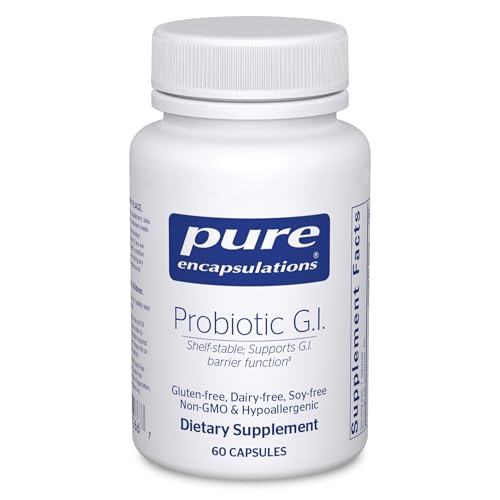
Cost per serving: $$ | 60 servings | 1 capsule per serving
Six named strains with only plant fiber and a vegetarian capsule.
Quick Stats
- Active ingredient + form: B. lactis Bl-04, L. acidophilus La-14, L. salivarius Ls-33, L. casei Lc-11, Streptococcus thermophilus St-21, B. bifidum Bb-06
- Dose per serving: 10 billion CFU (1 capsule)
- Dose vs. research: Strains are named, but amounts per strain are not listed and the blend has no trial of its own
- Third-party tested: Not stated (no NSF or USP listing found, November 2026)
- Certifications: Gluten-free, soy-free, dairy-free, non-GMO, vegetarian (label)
- Who should skip: People with a weakened immune system, unless their doctor approves
What We Like
The other ingredients are only cellulose and the capsule, which suits people with allergies or sensitivities. Every strain carries a code, and the listing is sold by Pattern, the brand’s authorized reseller.
Watch Out For
The label gives one total for the blend, so you cannot tell how much of each strain you get. The label notes that refrigeration may prolong viability and advises using it within 90 days of opening.
What Buyers Report
Buyers frequently mention that it works without fillers, is easy to swallow and needs no refrigeration.
Some find it expensive.
Bottom Line: The cleanest label here for people who react to additives.
8. Seed DS-01 Daily Synbiotic – Best Synbiotic
Our rating: 4.1/5
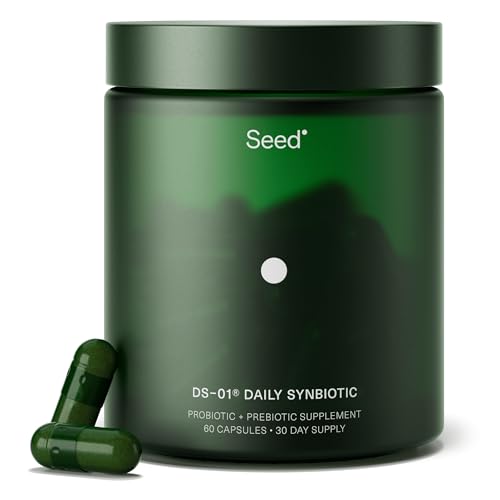
Cost per serving: $$$ | 30 servings | 2 capsules per serving
24 named strains plus pomegranate extract, in a capsule-within-a-capsule.
Quick Stats
- Active ingredient + form: 24 strains in four blends (Bifidobacterium and Lactobacillus species, each with a strain code), plus 400 mg pomegranate extract
- Dose per serving: 53.6 billion AFU (2 capsules)
- Dose vs. research: The finished product was tested at this dose in a 350-person bloating trial
- Third-party tested: Not stated (no NSF or USP listing found, November 2026)
- Certifications: Vegan (label)
- Who should skip: People with a weakened immune system, unless their doctor approves; start with 1 capsule if you have a sensitive stomach
What We Like
It is the only product here tested as a finished product in a large trial. In a 6-week randomized trial of 350 adults with bloating, DS-01 reduced bloating, gas and abdominal discomfort more than placebo, and more people reported rarely or never feeling bloated. Every strain is named, and Seed sells the listing.
Watch Out For
At about $2 a day it is the most expensive product here, which is why it ranks last. It counts bacteria in AFU (active fluorescent units) rather than CFU, so the numbers are not directly comparable. Some buyers report nausea, cramps or loose stools in the first days.
What Buyers Report
Buyers frequently mention less bloating, better regularity and the probiotic-plus-prebiotic design.
A large group calls it overpriced, and some report stomach upset when starting.
Bottom Line: The best-documented choice for bloating if the price fits your budget.
Ingredient Breakdown
Probiotics
Probiotics are live microbes that may benefit health when taken in adequate amounts. Effects depend on the strain, not just the species: two products labeled “Lactobacillus rhamnosus” can behave differently. That is why we gave the most credit to labels that name each strain.
Antibiotic-Associated Diarrhea
This is where the evidence is strongest. In meta-analyses, S. boulardii and LGG lowered the risk of diarrhea during antibiotics. A 2025 Cochrane review of 38 trials found probiotics may lower the risk of C. difficile diarrhea from 3.2% to 1.6%, a small absolute benefit, with low-certainty evidence.
Bloating and IBS
Trials show strain-specific effects: B. coagulans MTCC 5856 in IBS with diarrhea, NCFM plus Bi-07 for bloating, and Seed DS-01 for bloating in otherwise healthy adults. Still, the American Gastroenterological Association recommends probiotics for IBS only within clinical trials, because the evidence is still limited.
Transit Time and Regularity
In a dose-response trial, B. lactis HN019 shortened whole-gut transit time and reduced several digestive symptoms after two weeks.
How to Take Probiotic Supplements
- Pick for a reason: Choose a strain studied for your goal, such as S. boulardii or LGG during antibiotics, or a strain tested for bloating.
- Give it time: Take it daily for 4–8 weeks before judging; stop if nothing changes.
- With antibiotics: Start when the course starts. Many labels suggest taking bacterial probiotics a few hours apart from antibiotic doses; yeast probiotics such as S. boulardii are not killed by antibiotics.
- Start low: Gas and bloating are common in the first days; start with half the dose if your stomach is sensitive.
- Storage: Follow the label; heat and moisture reduce live counts.
For other digestive options, see our digestive enzyme supplements guide and psyllium husk supplements guide. For vaginal health strains, see our probiotics for vaginal health guide. For bovine colostrum, which some people take for gut support, see our colostrum supplements guide. For an amino acid often taken for gut support, see our L-glutamine supplements guide. For urinary tract support, see our D-mannose supplements guide.
Safety, Side Effects & Interactions
- Common side effects: Gas, bloating, and loose stools or constipation in the first week or two.
- Serious infections are rare but real: A systematic review of Saccharomyces fungemia found most cases occurred in people taking S. boulardii, often in intensive care or on tube feeding or intravenous nutrition.
- Medicines: Antifungal drugs can reduce the effect of S. boulardii. Ask your doctor if you take immune-suppressing medicines.
- Allergens: Florastor contains lactose; check the label if you avoid milk.
- Not a treatment: The AGA makes no recommendation for probiotics in Crohn’s disease, ulcerative colitis or IBS outside clinical trials.
Who Should Avoid It
- People with a weakened immune system or on chemotherapy, unless their doctor approves
- People with a central venous catheter, in intensive care, or recovering from major surgery
- Infants and young children, unless a doctor recommends a specific product
- People with a milk allergy (for lactose-containing products)
How to Choose Probiotic Supplements
Form and Bioavailability
Bacillus spores and S. boulardii survive stomach acid and room temperature well. Lactobacillus and Bifidobacterium strains depend on delayed-release capsules, packaging and storage.
Dosage – What to Look For
Look for the strain code and a CFU count “at expiration” rather than “at manufacture”. Higher CFU is not better by itself; a named strain at a studied dose beats a large unnamed blend.
Third-Party Testing
Few probiotics carry a supplement certification. In this guide, both Thorne products are listed by NSF, and FloraSport is also NSF Certified for Sport.
Cost Per Serving vs. Cost Per Bottle
Check the servings, not the capsule count: Florastor’s 30-capsule box lasts 15 days, while Jarrow’s 180-capsule bottle lasts six months.
Red Flags on the Label
- Proprietary blends with no strain codes
- CFU counts only “at time of manufacture”
- Claims to treat IBS, yeast infections or other diseases
- Dozens of species at very high CFU with no trial of the product
- Unknown sellers on the listing
Important: These supplements are not intended to diagnose, treat, cure, or prevent any disease. Results vary by individual. If you have a health condition or take medications, check with your doctor before adding any new supplement to your routine.
FAQ
What is the best probiotic for antibiotics?
S. boulardii (such as Florastor’s CNCM I-745) and LGG (Culturelle) have the most evidence for preventing diarrhea during antibiotics.
How many CFU should a probiotic have?
There is no single number. Look for the dose used in studies of that strain, often 1–20 billion CFU a day, rather than the highest count.
Do probiotics help with bloating?
Some strains have: B. coagulans MTCC 5856, NCFM plus Bi-07, and Seed DS-01 reduced bloating in trials. Results vary, and the AGA does not recommend probiotics for IBS outside trials.
Do probiotics need to be refrigerated?
Not always. Spore-forming Bacillus, S. boulardii and many shelf-stable capsules are made for room temperature; follow the label.
How long do probiotics take to work?
Trials usually measure results after 4–8 weeks. During antibiotics, start with the course.
Can I take a probiotic every day?
Most healthy adults can take one daily. People with a weakened immune system or a central line should ask a doctor first.
Our Take
Thorne Bacillus Coagulans is our top pick among probiotic supplements because it names a strain with a placebo-controlled trial, is NSF listed and needs no refrigeration. Thorne FloraSport 20B is the NSF Certified for Sport choice, and Culturelle Digestive Daily offers the most-studied single strain.
Choose Jarrow Saccharomyces Boulardii + MOS for the lowest daily cost, Metagenics UltraFlora Balance for two named, studied strains, Florastor during a course of antibiotics, Pure Encapsulations Probiotic G.I. for the cleanest label, or Seed DS-01 Daily Synbiotic if bloating is your main concern and the price fits.
Practical tip: pick one product for a specific goal, take it daily for a month, and stop if nothing changes. To feed the bacteria already in your gut, see our inulin supplements guide. Turkey tail extract has also been studied as a prebiotic; see our turkey tail supplements guide. Butyrate, a compound gut bacteria make from fiber, is also sold as a supplement; see our butyrate supplements guide.
Sources
- Bacillus coagulans MTCC 5856 supplementation in the management of diarrhea predominant Irritable Bowel Syndrome: a double blind randomized placebo controlled pilot clinical study (2016) — PubMed
- Dose-response effect of Bifidobacterium lactis HN019 on whole gut transit time and functional gastrointestinal symptoms in adults (2011) — PubMed
- Systematic review with meta-analysis: Lactobacillus rhamnosus GG in the prevention of antibiotic-associated diarrhoea in children and adults (2015) — PubMed
- Probiotic bacteria Lactobacillus acidophilus NCFM and Bifidobacterium lactis Bi-07 versus placebo for the symptoms of bloating in patients with functional bowel disorders (2011) — PubMed
- Systematic review with meta-analysis: Saccharomyces boulardii in the prevention of antibiotic-associated diarrhoea (2015) — PubMed
- A Randomized, Placebo-Controlled Trial Evaluating Multi-Species Synbiotic Supplementation for Bloating, Gas, and Abdominal Discomfort (2026) — PubMed
- Probiotics for the prevention of Clostridioides difficile-associated diarrhea in adults and children (2025) — Cochrane Database Syst Rev, PubMed
- AGA Clinical Practice Guidelines on the Role of Probiotics in the Management of Gastrointestinal Disorders (2020) — PubMed
- Epidemiology of Saccharomyces fungemia: A systematic review (2023) — PubMed
Labels, sellers and cost tiers last checked: November 9, 2026.
Update log
- November 9, 2026: First published. 8 products compared.
- November 12, 2026: Added a link to our colostrum supplements guide. No product or ranking changes.
- November 14, 2026: Added a link to our L-glutamine supplements guide. No product or ranking changes.
- November 15, 2026: Added a link to our D-mannose supplements guide. No product or ranking changes.
- November 16, 2026: Added a link to our inulin supplements guide. No product or ranking changes.
- November 18, 2026: Added a link to our turkey tail supplements guide.
- November 20, 2026: Added a link to our butyrate supplements guide. No product or ranking changes.


