
| Best Overall | Best Studied Extract | Best Alcohol-Free Liquid | |
|---|---|---|---|
| Pick | Nutricost Echinacea | A.Vogel Echinaforce Tablets | Herb Pharm Echinacea Alcohol-Free |
| Why | 800 mg of a 10:1 Echinacea purpurea extract in two capsules, at the lowest daily cost here. | A fresh-plant extract made from the same 95% herb and 5% root mix used in a 4-month prevention trial. | An organic root extract in a glycerin base, with no alcohol and no other added ingredients. |
| Cost per serving | $ | $ | $$$ |
Quick answer: Of the echinacea supplements we compared, Nutricost Echinacea ranked first: two capsules give 800 mg of a concentrated Echinacea purpurea extract for about 12 cents a day, with a short ingredient list. A.Vogel Echinaforce scored the same and is the pick if you want the extract type with the strongest trial behind it, and Herb Pharm is the alcohol-free liquid.
Echinacea, or purple coneflower, is a North American plant in the daisy family. Supplements use one of three species, most often Echinacea purpurea, and different parts of the plant: the flowering tops, the root, or both. Those choices change what is in the product, so two echinacea labels with the same milligrams can contain quite different things.
The research is mostly about colds. The National Center for Complementary and Integrative Health (NCCIH) says echinacea may slightly reduce your chances of catching a cold, while it is still unclear whether it shortens one. Expect a modest effect at best, not protection.
We compared eight echinacea supplements on species and plant part, amount per day, testing, other ingredients, cost per day and who sells the listing, plus recent FDA recalls, using our how we test criteria. Every product here made our shortlist, and our ratings show how they rank against each other. Where two products scored the same or very close, we explain the order in their reviews.
Our Top Picks
Best Overall: Nutricost Echinacea – CHECK PRICE →
Best Studied Extract: A.Vogel Echinaforce Tablets – CHECK PRICE →
Best Standardized Capsule: Life Extension Echinacea Elite – CHECK PRICE →
Best Alcohol-Free Liquid: Herb Pharm Echinacea Alcohol-Free – CHECK PRICE →
Best Whole-Plant Liquid: MaryRuth’s Organic Echinacea Purpurea Drops – CHECK PRICE →
Most Popular: Nature’s Way Echinacea Purpurea Herb – CHECK PRICE →
Comparison Table
| Rank | Product | Species and Plant Part | Amount per Serving | Servings per Day | Cost per Day | Third-Party Tested | Best For |
|---|---|---|---|---|---|---|---|
| 1 | Nutricost | E. purpurea aerial, 10:1 extract | 800 mg extract | 1 | $ | Brand claim | Best Overall |
| 2 | A.Vogel Echinaforce | E. purpurea fresh herb (95%) + root (5%) | 400 mg fresh tincture equivalent per tablet | 2 to 3 tablets | $ | Not stated | Studied Extract |
| 3 | Life Extension | E. purpurea aerial + E. angustifolia root, standardized | 250 mg extract | 2 | $$ | Brand claim | Standardized Capsule |
| 4 | Gaia Herbs | E. purpurea root, seed, aerial + E. angustifolia root | 955 mg blend, 3 mg alkylamides | 5 (short course) | $$$ | Brand claim | Short-Term Formula |
| 5 | Herb Pharm | E. purpurea root, glycerin extract | 0.7 mL | 2 to 5 | $$$ | Not stated | Alcohol-Free Liquid |
| 6 | MaryRuth’s | E. purpurea whole plant, glycerin extract | 1 mL (1.18 g extract) | 1 to 3 | $$ | Brand claim | Whole-Plant Liquid |
| 7 | Oregon’s Wild Harvest | E. purpurea tops and root + E. angustifolia root, whole herb | 800 mg herb | 2 | $$$ | Brand claim | Whole-Herb Capsule |
| 8 | Nature’s Way | E. purpurea stem, leaf and flower powder | 1.2 g herb | 3 | $$$ | Not stated | Most Popular |
Cost tiers per day at the label’s daily use: $ under $0.35 · $$ $0.35–$0.65 · $$$ over $0.65 (checked November 2026). Where a label gives a range, the tier uses a middle amount. None of these products was listed in NSF’s dietary supplement database when we checked.
In-Depth Reviews: Top 8 Echinacea Supplements of 2026
1. Nutricost Echinacea – Best Overall
Our rating: 4.8/5

Cost per serving: $ | 120 servings | 2 capsules per serving
A concentrated purpurea extract at the lowest daily cost in this guide.
Quick Stats
- Active ingredient + form: Echinacea purpurea aerial parts, 10:1 extract, 800 mg
- Dose per serving: 800 mg extract (2 capsules)
- Dose vs. research: Trials used many different preparations, so there is no single proven dose; this is an aerial-parts extract like those in the prevention trials
- Third-party tested: The listing says third-party tested but does not name a lab
- Certifications: None from an outside certifier
- Who should skip: People allergic to ragweed, daisies or related plants, people taking immunosuppressant medicines unless their doctor approves, and anyone pregnant or breastfeeding unless their doctor approves
What We Like
Two capsules give 800 mg of a 10:1 extract, and a 240-capsule bottle lasts four months at about 12 cents a day. The other ingredients are rice flour, the cellulose capsule, magnesium stearate and silica. The listing is sold by eSupplements, which owns the Nutricost brand. A.Vogel Echinaforce scored the same and the scores were close; Nutricost ranks first because it costs less than half as much per day and its label states the full extract amount in milligrams.
Watch Out For
The label does not standardize the extract to any marker compound, so the 10:1 ratio is the only clue to strength. Some buyers find the capsules large, and one felt newer capsules were lighter than older ones.
What Buyers Report
Buyers frequently mention good value, no taste and that it is easy on the stomach.
Capsule size is the main complaint.
Bottom Line: The best mix of extract amount, short label and price.
2. A.Vogel Echinaforce Tablets – Best Studied Extract
Our rating: 4.7/5

Cost per serving: $ | 120 servings | 1 tablet per serving
A fresh-plant purpurea extract with the herb-to-root mix used in the largest prevention trial.
Quick Stats
- Active ingredient + form: Fresh Echinacea purpurea extract, 6.68 mg per tablet, made from 400 mg of fresh-plant tincture (about 95% herb and 5% root)
- Dose per serving: 1 tablet; the label suggests 2 to 3 tablets a day
- Dose vs. research: A 2012 trial used an alcohol extract of fresh E. purpurea made from 95% herb and 5% root for 4 months; the tablet form and daily amount may differ from the trial
- Third-party tested: Not stated on the label
- Certifications: None from an outside certifier
- Who should skip: People allergic to ragweed, daisies or related plants, people taking immunosuppressant medicines unless their doctor approves, and anyone pregnant or breastfeeding unless their doctor approves
What We Like
It is made from freshly harvested plants with the same herb-to-root mix as the trial extract, which in that study cut the number of colds and was as well tolerated as placebo. The tablets are small, the cost is about 29 cents a day at three tablets, and the listing is sold by Bioforce USA, the brand’s US company.
Watch Out For
The tablets add more fillers than most products here, including mannitol, sorbitol, croscarmellose sodium, magnesium salts, MCT oil and sucrose esters. No testing is stated on the listing, and the buyer base is smaller than for Nature’s Way.
What Buyers Report
Buyers frequently mention tiny, easy tablets, and many are long-time users.
Few complaints.
Bottom Line: The extract type with the strongest trial behind it, at a low daily cost.
3. Life Extension Echinacea Elite – Best Standardized Capsule
Our rating: 4.6/5

Cost per serving: $$ | 60 servings | 1 capsule per serving
Two species, each standardized to a stated marker compound.
Quick Stats
- Active ingredient + form: Echinacea purpurea aerial extract 125 mg (4% phenolics) and Echinacea angustifolia root extract 125 mg (4% echinacosides)
- Dose per serving: 250 mg extract (1 capsule; the label suggests 1 capsule twice a day)
- Dose vs. research: Combines the two species most used in trials; no trial tested this exact product
- Third-party tested: Not stated on the label; Life Extension says it offers a certificate of analysis for every product
- Certifications: None from an outside certifier
- Who should skip: People allergic to ragweed, daisies or related plants, people taking immunosuppressant medicines unless their doctor approves, and anyone pregnant or breastfeeding unless their doctor approves
What We Like
It is the only capsule here that standardizes both extracts, so you know how much of the marker compounds you get. It costs about 37 cents a day, the capsules are small, and Life Extension describes its quality testing in more detail than most brands.
Watch Out For
The other ingredients include microcrystalline cellulose, maltodextrin and silica. It has the smallest buyer base in this guide, many of its reviews come from Amazon’s Vine program, and buyers are split on how well it works.
What Buyers Report
Buyers frequently mention the dual standardized extract and small capsules.
Results are mixed in the reviews.
Bottom Line: The most precisely labeled capsule here, from a brand that shares its test reports.
4. Gaia Herbs Echinacea Supreme – Best Short-Term Formula
Our rating: 4.5/5

Cost per serving: $$$ | 30 servings | 2 capsules per serving
A liquid capsule that states its alkylamides, made for a few days of use.
Quick Stats
- Active ingredient + form: Herbal extract blend 955 mg of organic Echinacea purpurea root, seed and aerial parts, organic Echinacea angustifolia root, and an E. purpurea root CO2 extract
- Dose per serving: 955 mg blend with 3 mg alkylamides (2 capsules); the label says 2 capsules 5 times a day for 2 days, repeated for 2 more days if needed
- Dose vs. research: A short, frequent course; no trial tested this exact product
- Third-party tested: The brand says it tests for purity, label potency, heavy metals and pesticides; no certificate for this product is shown
- Certifications: Vegan, gluten-free, dairy-free, soy-free (listing)
- Who should skip: People allergic to ragweed, daisies or related plants, people taking immunosuppressant medicines unless their doctor approves, and anyone pregnant or breastfeeding unless their doctor approves
What We Like
It is the only product here that states its alkylamides, compounds thought to be among echinacea’s active ingredients. The only other ingredients are vegetable glycerin, water and the vegan capsule, and the listing is sold by Pattern, the brand’s authorized Amazon reseller. Herb Pharm scored the same; Gaia ranks ahead because it states a measured amount of an active compound.
Watch Out For
Ten capsules a day means a 60-capsule bottle covers about six days, which makes it the most expensive product here per day. It is meant for short use, not daily prevention.
What Buyers Report
Buyers frequently mention good quality and that it is well tolerated.
Price is the main complaint.
Bottom Line: A well-labeled short-course formula at a premium price.
5. Herb Pharm Echinacea Alcohol-Free – Best Alcohol-Free Liquid
Our rating: 4.4/5

Cost per serving: $$$ | about 42 servings | 0.7 mL per serving
An organic root extract in glycerin, for people who avoid alcohol tinctures.
Quick Stats
- Active ingredient + form: Organic Echinacea purpurea root, glycerin extract, 0.7 mL per serving
- Dose per serving: 0.7 mL (one squeeze of the dropper); Herb Pharm suggests 2 to 5 times a day in water or juice
- Dose vs. research: A root-only preparation; a large 2010 trial of root-based tablets found no significant effect on cold length
- Third-party tested: Not stated; the brand shows an “identity verified” badge
- Certifications: Certified organic, non-GMO, gluten-free, vegan (brand)
- Who should skip: People allergic to ragweed, daisies or related plants, people taking immunosuppressant medicines unless their doctor approves, and anyone pregnant or breastfeeding unless their doctor approves
What We Like
The base is organic glycerin and water with no alcohol, so it mixes easily into water or juice. Herb Pharm farms many of its own herbs, has a large buyer base, and Amazon sells the listing.
Watch Out For
A 1-ounce bottle lasts only one to two weeks at several doses a day, so the daily cost adds up. Some buyers dislike the taste, and one received a broken bottle.
What Buyers Report
Buyers frequently mention the alcohol-free base, easy mixing in water and use through the winter.
Taste and how fast the bottle runs out draw complaints.
Bottom Line: The alcohol-free liquid to choose, if you are fine with a small bottle.
6. MaryRuth’s Organic Echinacea Purpurea Drops – Best Whole-Plant Liquid
Our rating: 4.3/5

Cost per serving: $$ | about 30 servings | 1 mL per serving
A whole-plant liquid with a mild taste.
Quick Stats
- Active ingredient + form: Organic Echinacea purpurea whole-plant extract, 1.18 g per 1 mL
- Dose per serving: 1 mL; the label suggests 1 to 3 times a day for ages 14 and up
- Dose vs. research: A whole-plant preparation; no trial tested this exact product
- Third-party tested: The brand says its products are tested through the Clean Label Project program, but we could not find this product in Clean Label Project’s public search as of November 2026
- Certifications: Organic (label)
- Who should skip: Children under 14, people allergic to ragweed, daisies or related plants, people taking immunosuppressant medicines unless their doctor approves, and anyone pregnant or breastfeeding unless their doctor approves
What We Like
The only other ingredients are glycerin and water, and buyers often describe a sweet, easy taste. At one serving a day it costs less per day than the two capsules below it. Oregon’s Wild Harvest and Nature’s Way scored close to it; MaryRuth’s ranks ahead of them because one serving a day costs less than either at its label dose, and the liquid is easier for people who dislike capsules.
Watch Out For
The buyer base is small, and a 1-ounce bottle lasts about a month at one serving a day, or 10 days at three.
What Buyers Report
Buyers frequently mention immune support and a pleasant, honey-like taste.
Few complaints.
Bottom Line: An easy-tasting whole-plant liquid for people who skip capsules.
7. Oregon’s Wild Harvest Echinacea – Best Whole-Herb Capsule
Our rating: 4.2/5

Cost per serving: $$$ | 45 servings | 2 capsules per serving
Organic whole herb from two species, with nothing added but the capsule.
Quick Stats
- Active ingredient + form: Organic Echinacea purpurea tops 330 mg, E. purpurea root 330 mg and E. angustifolia root 140 mg (whole herb, not an extract)
- Dose per serving: 800 mg herb (2 capsules; the label suggests 2 capsules twice a day)
- Dose vs. research: Ground herb rather than an extract; no trial tested this exact product
- Third-party tested: The brand says it tests its herbs in-house; no outside lab is named
- Certifications: Organic (label)
- Who should skip: People allergic to ragweed, daisies or related plants, people taking immunosuppressant medicines unless their doctor approves, and anyone pregnant or breastfeeding unless their doctor approves
What We Like
The capsule is made of pullulan and holds nothing but organic echinacea, the cleanest label in this guide. It includes both the tops and the root of purpurea plus angustifolia root, and the brand sells the listing.
Watch Out For
At about $1.06 a day it is one of the most expensive options here, and ground herb is less concentrated than an extract.
What Buyers Report
Buyers frequently mention organic quality and no aftertaste.
Few complaints; one buyer received a broken bottle.
Bottom Line: The cleanest label here, at a high daily cost.
8. Nature’s Way Echinacea Purpurea Herb – Most Popular
Our rating: 4.1/5
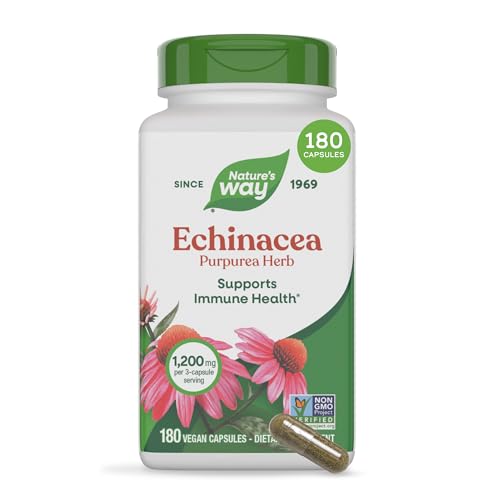
Cost per serving: $$$ | 60 servings | 3 capsules per serving
The most-reviewed echinacea in our lineup, as a simple organic herb powder.
Quick Stats
- Active ingredient + form: Organic Echinacea purpurea stem, leaf and flower powder, 1.2 g per 3 capsules
- Dose per serving: 1.2 g herb (3 capsules); the label suggests 3 capsules 3 times a day
- Dose vs. research: Ground herb rather than an extract; no trial tested this exact product
- Third-party tested: Not stated on the label
- Certifications: Organic, non-GMO (label)
- Who should skip: People with autoimmune conditions or allergies to plants in the daisy family, as the label itself warns, people taking immunosuppressant medicines unless their doctor approves, and anyone pregnant or breastfeeding
What We Like
It has by far the largest buyer base here, the label lists only the herb, the cellulose capsule and silica, and Amazon sells the listing. The label’s cautions are the clearest in this guide.
Watch Out For
Nine capsules a day is a lot to swallow, and at the full label amount a 180-capsule bottle lasts 20 days, at about 84 cents a day. Many buyers who comment on dosage call the number of capsules a drawback.
What Buyers Report
Buyers frequently mention good quality, value and trust in the brand, and many use it for immune support in cold season.
The number of capsules per day is the main complaint.
Bottom Line: A trusted, simple herb powder if you do not mind many capsules.
Products We Left Out
- Wild & Organic Echinacea drops: The glycerin liquid adds hickory flavor and contains soy, and it scored below every product above.
- Nature’s Truth Echinacea: Two capsules give only 130 mg of extract; the front label’s “1,300 mg” is the amount of herb the extract is said to equal.
- Swanson Echinacea: Too few recent buyers for us to judge it against the rest.
- Solaray Echinacea: The listing was sold by a third-party seller we could not confirm as authorized.
- Herb Pharm Super Echinacea and A.Vogel Echinaforce drops: We include one product per brand; both brands’ picks are above.
- Echinacea with goldenseal, elderberry or zinc: Combination products are outside this guide.
- Several large brands: Left out under our brand rules.
Ingredient Breakdown
Species and Plant Parts
Echinacea purpurea is the most common species in supplements, and its flowering tops (aerial parts) are what most prevention trials used. Echinacea angustifolia root is the second most common. Some products use only the root, some only the tops, and some mix both species, so check the label for both the species and the plant part.
Alkylamides, Phenolics and Echinacosides
These are compounds researchers measure in echinacea. Gaia Herbs states its alkylamides, and Life Extension standardizes to phenolics and echinacosides. Most other labels give only the extract or herb weight.
Extracts, Ratios and Fresh Plants
A “10:1” ratio means the extract was made from about ten times its weight in herb. It does not tell you the amount of any active compound. Fresh-plant extracts, such as A.Vogel’s, are made from just-harvested plants, and NCCIH notes that even soil conditions can change how active an extract is.
What the Research Shows
- Preventing colds: A 2014 Cochrane review of 24 trials with 4,631 people found that no single prevention trial showed a significant difference, but pooling them suggested a 10% to 20% lower risk of catching a cold. A 2019 meta-analysis found a similar small effect on upper respiratory infections and called its clinical value debatable.
- The largest prevention trial: In a 2012 trial of 755 healthy adults, a fresh E. purpurea extract (95% herb, 5% root) taken for 4 months reduced the number of cold episodes, with side effects similar to placebo.
- Shortening a cold: The Cochrane review found that only one of seven treatment trials showed a shorter cold. A 2010 trial of 719 people taking root-based tablets found about half a day shorter, which was not statistically significant.
- Older, more positive pooling: A 2007 meta-analysis of 14 studies found lower odds of catching a cold and colds about 1.4 days shorter, but later reviews with stricter methods found smaller effects.
How to Take Echinacea
- Follow the label: Amounts differ a lot between products because they use different plant parts and forms.
- Prevention takes consistency: The largest prevention trial gave the extract daily for 4 months, and the effect grew with better adherence.
- For a cold, start early: Short-course products such as Gaia’s are designed to start at the first sign of a cold and stop after a few days.
- Mix liquids into water or juice: Glycerin liquids such as Herb Pharm and MaryRuth’s can be taken in a small glass of water.
- Related guides: For other immune support supplements, see our elderberry supplements guide, zinc supplements guide and vitamin C supplements guide.
Safety, Side Effects & Interactions
- Allergy: Echinacea is related to ragweed, daisies and sunflowers, and NCCIH says some people have allergic reactions that may be severe.
- Side effects: The most common are digestive symptoms such as nausea or stomach pain.
- Medicines: NCCIH says the evidence on interactions with some drugs processed by the liver is conflicting, and there are theoretical reasons to suspect interactions with immunosuppressants and caffeine.
- Pregnancy and breastfeeding: NCCIH says some studies suggest echinacea is possibly safe for up to 7 days in the first trimester, and little is known about breastfeeding.
- Children: Some children in a clinical trial developed rashes. Talk with a child’s health care provider first.
- Short-term use: NCCIH says E. purpurea extracts are likely safe for most adults for short periods.
Who Should Avoid It
- People allergic to ragweed, daisies, sunflowers or other plants in the same family
- People taking immunosuppressant medicines, unless their doctor approves
- People with autoimmune conditions, unless their doctor approves (Nature’s Way’s label carries this warning)
- Anyone pregnant or breastfeeding, unless their doctor approves
- Children, unless their health care provider recommends it
How to Choose an Echinacea Supplement
Species and Plant Part
Look for the species (purpurea or angustifolia) and the plant part on the label. Aerial-part E. purpurea extracts have the most prevention research.
Extract or Herb
Extracts are more concentrated than ground herb. A capsule of ground herb needs more capsules per day.
Stated Compounds
A stated amount of alkylamides, phenolics or echinacosides lets you compare strength. Few labels give one.
Other Ingredients
Liquids usually add glycerin and water; tablets add more fillers. Check for flavors or soy if you avoid them.
Testing
No echinacea product here was listed in NSF’s database. Most brands describe in-house testing or claim third-party testing without naming a lab.
Cost per Day
Products here range from about 12 cents a day to several dollars a day for short-course formulas.
Red Flags on the Label
- No species or plant part listed
- Large “equivalent” milligram claims based on extract ratios
- Claims to cure or prevent colds, flu or any infection
- Listings sold by unknown third-party sellers
Important: These supplements are not intended to diagnose, treat, cure, or prevent any disease. Results vary by individual. If you have a health condition or take medications, check with your doctor before adding any new supplement to your routine.
FAQ
What is the best echinacea supplement?
In our comparison, Nutricost Echinacea ranked first for its 800 mg extract, short ingredient list and low daily cost. A.Vogel Echinaforce scored the same and matches the extract type used in the largest prevention trial, and Herb Pharm is the alcohol-free liquid pick.
Does echinacea work for colds?
Research suggests it may slightly lower the chance of catching a cold. Whether it shortens a cold is still unclear, and several large trials found little or no effect on cold length.
How much echinacea should I take a day?
There is no single proven dose because trials used many different preparations. Follow the label of the product you choose.
Can I take echinacea every day?
The largest prevention trial gave it daily for 4 months. NCCIH describes it as likely safe for most adults for short periods, so ask your doctor about longer use.
Who should not take echinacea?
People allergic to ragweed or daisies, people taking immunosuppressant medicines, and anyone pregnant or breastfeeding should check with a doctor first.
Is echinacea purpurea or angustifolia better?
Most prevention trials used E. purpurea aerial parts. Some products combine it with E. angustifolia root, but there is no clear evidence that one species is better.
Our Take
Nutricost Echinacea is our top pick among echinacea supplements for its concentrated purpurea extract, short label and low cost. A.Vogel Echinaforce is the pick if you want the extract type from the largest prevention trial, and Life Extension Echinacea Elite is the most precisely standardized capsule.
Choose Gaia Herbs Echinacea Supreme for a short course at the start of a cold, Herb Pharm or MaryRuth’s for an alcohol-free liquid, Oregon’s Wild Harvest for the cleanest whole-herb capsule, or Nature’s Way for a popular organic powder.
Practical tip: check the species and plant part on the label, expect a modest effect at best, and skip echinacea if you are allergic to ragweed or daisies.
Sources
- Echinacea — National Center for Complementary and Integrative Health
- Echinacea for preventing and treating the common cold (2014 Cochrane review) — PubMed
- Safety and Efficacy Profile of Echinacea purpurea to Prevent Common Cold Episodes: A Randomized, Double-Blind, Placebo-Controlled Trial (2012) — PubMed
- Echinacea for treating the common cold: a randomized trial (2010) — PubMed
- Evaluation of echinacea for the prevention and treatment of the common cold: a meta-analysis (2007) — PubMed
- Echinacea for the prevention and treatment of upper respiratory tract infections: A systematic review and meta-analysis (2019) — PubMed
- Echinacea Alcohol-Free — Herb Pharm
- Safeguarding Your Health — Life Extension
Labels, sellers and cost tiers last checked: November 21, 2026.
Update log
- November 21, 2026: First published. 8 products compared.


